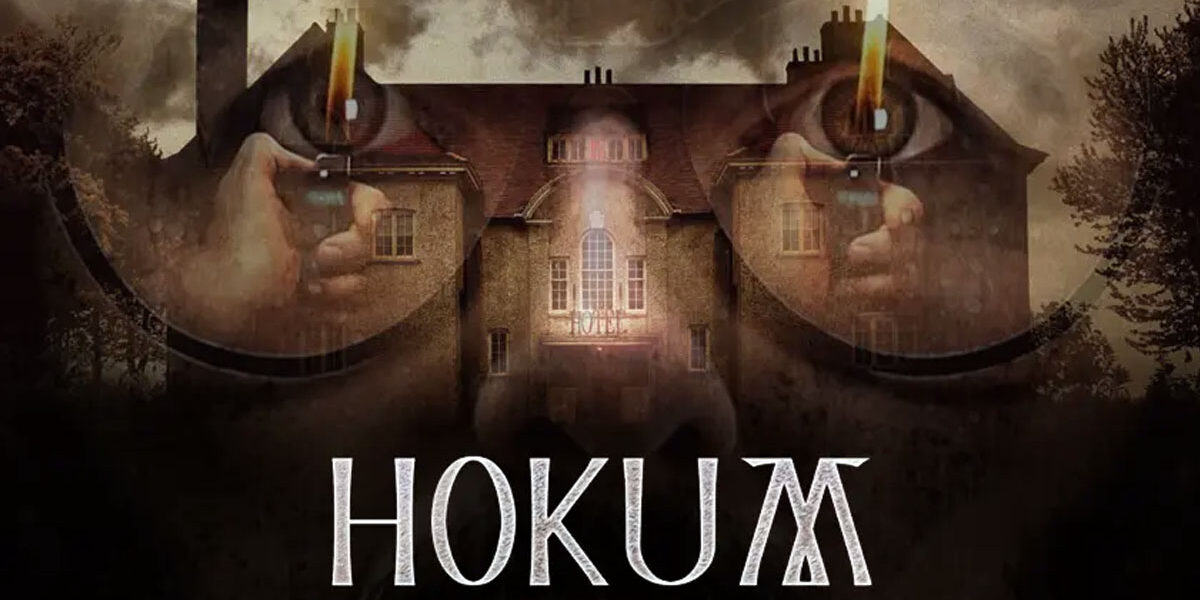
When I first heard that Adam Scott was going to lead an Irish folk horror film, my curiosity was immediately piqued. We are so heavily accustomed to seeing him thrive in deadpan comedies or navigate the sharp, sterile corridors of corporate thrillers that throwing him into a rain-soaked, gothic nightmare felt like a massive, unpredictable swing. So, in this comprehensive Hokum movie review, we are going to dive incredibly deep into Damian McCarthy’s 2026 cinematic nightmare. We will explore exactly how the narrative blends deeply rooted personal trauma with terrifying, ancient folklore, and determine whether this highly anticipated, deeply unsettling feature actually delivers on its spine-tingling promises.
If there is one prominent lesson modern psychological horror has taught us over the past decade, it is that unresolved grief and decaying, isolated buildings are a remarkably terrible combination for anyone’s mental health. You take a fundamentally broken person, strip away their support system, place them in a remote, unfamiliar location, and simply wait for the literal and metaphorical ghosts to show up. It is a cinematic formula we know exceptionally well. Yet, somehow, this particular film manages to take that incredibly familiar recipe and make it taste surprisingly brand new, injecting a fresh dose of misery and dread into the haunted house subgenre.
Setting the Scene: Grief, Isolation, and the Bilberry Woods Hotel
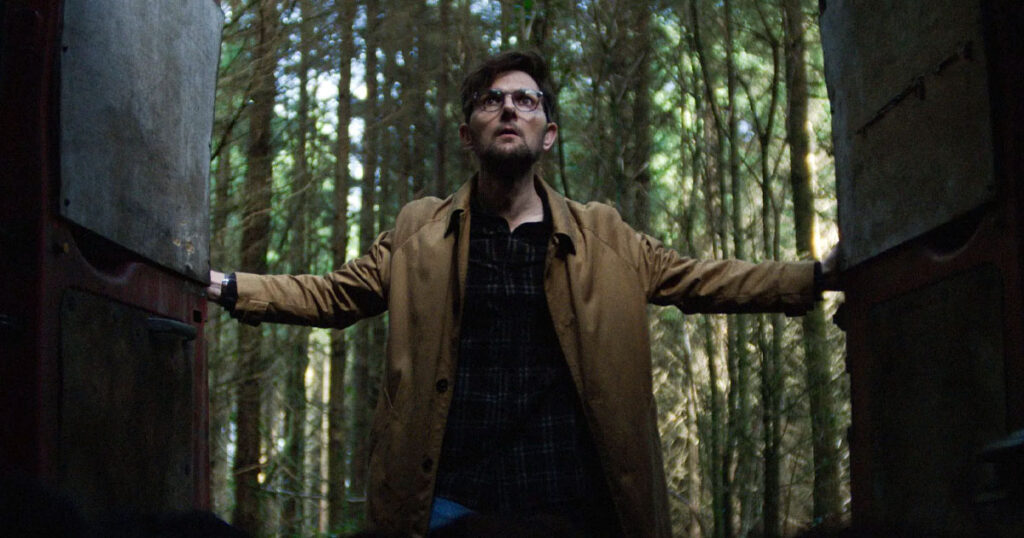
The core of the story centers entirely around Ohm Bauman, a cynical and exhausted American novelist who is desperately trying to finish the final, highly anticipated chapter of his widely successful dark fantasy book series. Suffering from severe, crippling writer’s block and a lingering, suffocating depression following a recent family tragedy, Ohm decides he needs a drastic change of scenery to force the words onto the page. He ultimately travels to the Bilberry Woods Hotel, a massive, decaying structure nestled deep in rural Ireland.
His official, stated reason for the transatlantic trip is to finally scatter his late parents’ ashes in a place they once loved. However, his unofficial, unspoken reason is clearly a desperate, somewhat pathetic search for absolute isolation. He wants to disappear. But, as anyone who actively watches horror movies will eagerly tell you, seeking total isolation in an empty, echoing, off-season Irish hotel is quite literally never a good idea. The hotel itself immediately feels hostile, as if the damp wallpaper and creaking floorboards resent his intrusion.
Local Legends: The Witch of the Honeymoon Suite
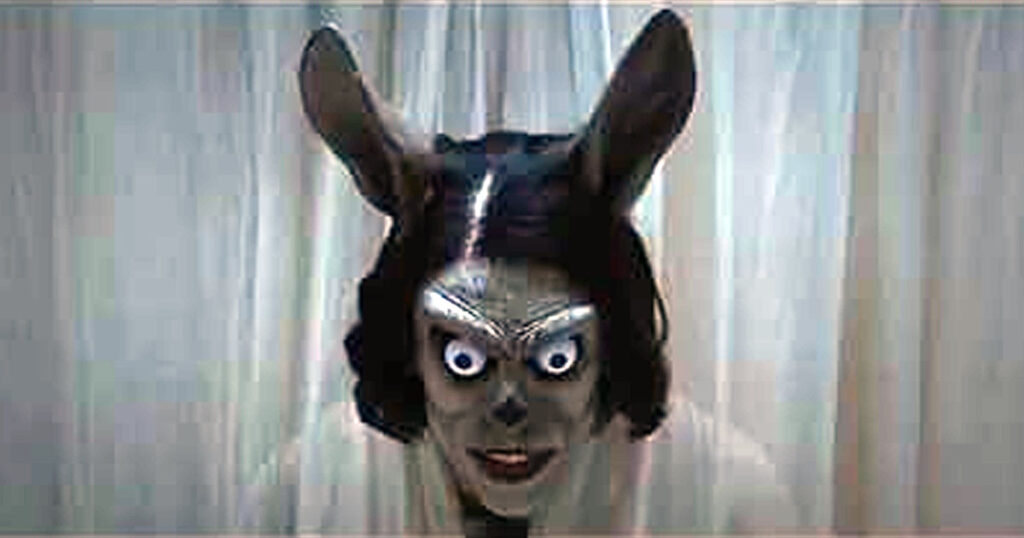
Almost immediately upon his arrival at the gloomy estate, the local folklore begins to casually creep into his daily routine. The hotel staff, an eccentric, tight-lipped, and mildly unsettling bunch of locals, casually mention a dark, whispered legend to their newest guest. They speak in hushed tones of an ancient, vengeful witch who supposedly haunts the hotel’s permanently locked-off honeymoon suite—a room that has not been opened to the public in decades.
According to the terrifying local myth, this malevolent entity doesn’t just scare people; she allegedly drags corrupted souls screaming through a subterranean underworld wrapped in rusted iron chains. At first, Ohm entirely dismisses these morbid tales with a scoff. He is a modern, rational man who literally writes fictional monsters for a living, so he naturally views their morbid ghost stories as nothing more than manufactured local color meant to artificially spook wealthy tourists. He even tries to use the legends as cheap inspiration for his stalled novel, recording his sarcastic thoughts on a vintage cassette tape recorder he carries everywhere.
A Murder Mystery Wrapped in the Supernatural
But then, the heavy, oppressive atmosphere of the hotel profoundly shifts. A shocking, unexplained disappearance occurs in the nearby village, which local authorities quickly link back to the hotel’s recently hosted, chaotic Halloween party. Suddenly, Ohm is violently pulled out of his self-imposed, melancholic isolation and thrust into a very real-world, gritty murder mystery.
This unexpected crime investigation begins to collide violently with the bizarre, supernatural elements he had initially mocked. The boundaries between the real-world danger of a potential killer wandering the grounds and the ghostly threat lurking behind the honeymoon suite’s door begin to blur beyond recognition. Ohm is left questioning not only the safety of his physical surroundings but the fundamental stability of his own deteriorating mind.
Adam Scott’s Masterclass in Internal Terror
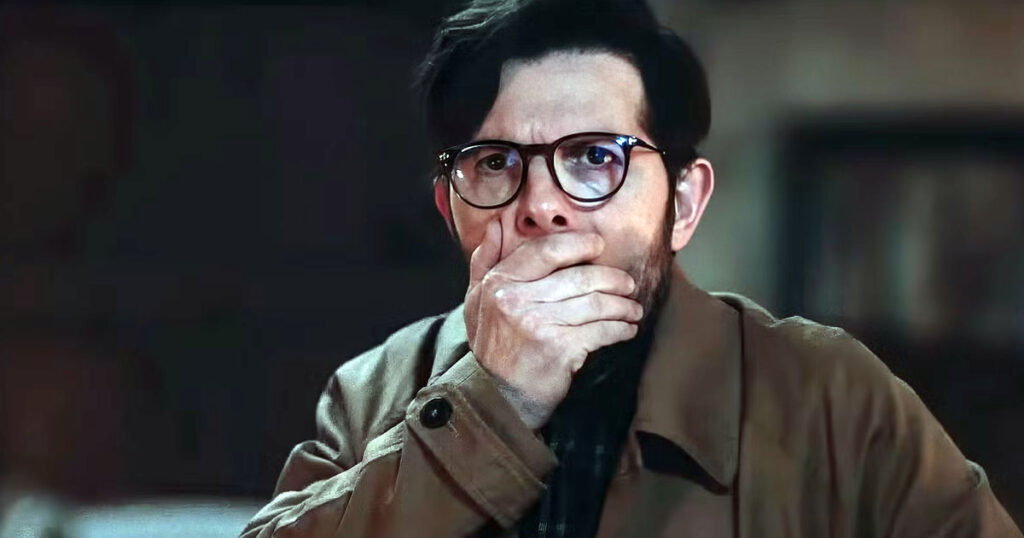
Let us take a moment to talk specifically about Adam Scott. Throughout the process of writing this Hokum movie review, I have felt a constant need to emphasize just how phenomenal and out-of-character he is in this demanding role. Ohm Bauman is not a particularly likable or heroic protagonist. He is sarcastic, incredibly bitter, heavily medicated, and entirely wrapped up in the suffocating blanket of his own miseries.
He speaks to the helpful (if creepy) hotel staff with a cutting, dismissive dryness that borders on cruelty, making it almost hard to watch at times. Yet, Scott masterfully infuses the arrogant character with such a deep, undeniable well of unspoken pain that you simply cannot help but root for him to survive. We have certainly seen him play with much darker, cynical themes in critically acclaimed shows like Severance, but here, completely stripped of any comedic safety net, he carries the entire emotional weight of a feature film squarely on his shoulders.
Scott’s performance is brilliantly anchored by a quiet, simmering bitterness. He rarely screams, thrashes, or overreacts to the horrors around him. Instead, the audience witnesses the terror slowly breaking his fragile mind through brilliant micro-expressions—a twitch of the eye, a sharp inhale, a trembling grip. Watching him wander the pitch-dark corridors at 3 AM, desperately clutching his tape recorder like a protective talisman, is an absolute masterclass in subtle, internal, psychological acting.
The Supporting Cast: Gritty, Irish, and Unsettling
While Scott dominates the screen time, the supporting cast absolutely deserves massive praise for building the film’s paranoid world. Actors like Peter Coonan and David Wilmot bring a distinctly authentic, gritty Irish flavor to the narrative. They do not play caricatures; instead, they exist somewhere perfectly ambiguous between overly welcoming, gossiping locals and shady, potentially dangerous suspects.
Every interaction Ohm has with the staff is laced with a thick layer of underlying tension. You are never quite sure if the groundskeeper is genuinely trying to protect the American writer from a local curse, or if he is actively preparing to feed him to whatever unspeakable horror is currently lurking in the shadows of the honeymoon suite. Their performances add a vital layer of mistrust to every single conversation.
Damian McCarthy’s Directorial Brilliance
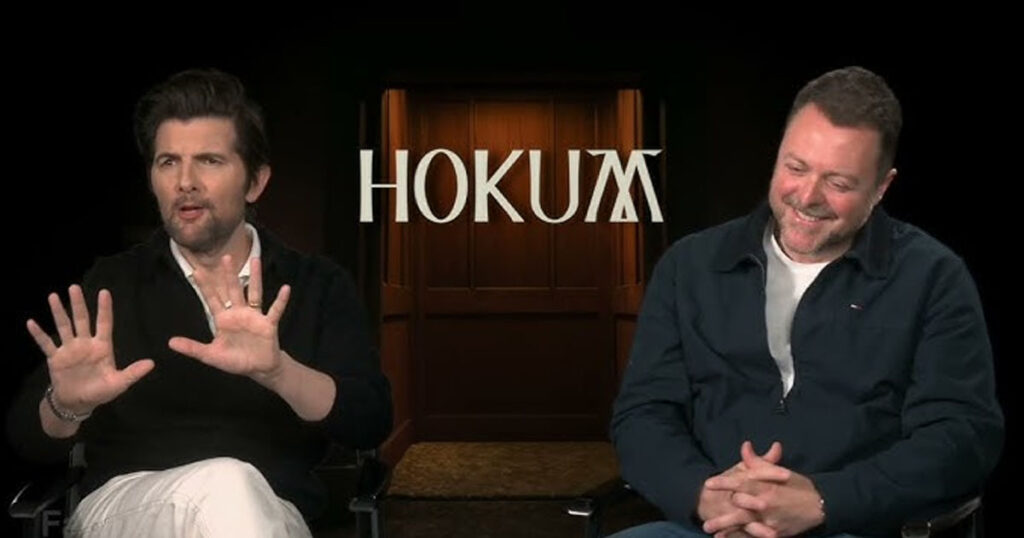
Director Damian McCarthy has been steadily building a fierce, undeniable reputation for crafting airtight, claustrophobic nightmares that linger in your psyche. If you have experienced his previous, highly effective works like Caveat or Oddity, you know exactly what specific, agonizing kind of dread he excels at manufacturing. He completely refuses to rely on cheap, sudden loud noises or predictable jump scares to terrify his audience.
Instead, McCarthy actively uses the very architecture of the Bilberry Woods Hotel as a weapon against the viewer. He frequently locks the camera strictly into Ohm’s limited, panicked point of view for agonizingly long, unbroken stretches of film. You find yourself sitting in the theater, intensely staring into the pitch-black corners of a dusty hotel room, feeling your own eyes playing vicious tricks on you, genuinely wondering if that tall, unnatural shadow in the corner just shifted its weight.
The production design of the hotel is essentially a primary character all by itself. It feels impossibly ancient, as if the building is actively breathing with a heavy, rotting gothic texture. The lighting is intentionally sparse and sickly yellow, while the peeling walls constantly feel like they are slowly closing in on the protagonist. There is one highly specific, dialogue-free sequence involving a jammed, vintage dumbwaiter in the kitchen that is easily one of the most physically stressful and anxiety-inducing things I have watched all year. McCarthy understands on a cellular level that the agonizing anticipation of a scare is almost always significantly worse than the actual scare itself. He maliciously milks every single ounce of tension out of an empty, silent hallway before finally, mercifully letting the audience breathe again.
The Flaws: Pacing and Genre-Hopping
However, as immersive as the experience is, the movie is certainly not without its noticeable flaws. About halfway through the two-hour runtime, the narrative violently pivots. It moves slightly away from the creeping, ghostly folklore that defined the first act and starts leaning surprisingly heavily into a grounded, procedural crime-thriller structure. As Ohm essentially deputizes himself and begins investigating the missing woman from the Halloween party, the film temporarily transforms into a bleak, rainy detective story.
For some viewers, this abrupt shift in tone might feel incredibly jarring and somewhat disjointed. The terrifying, supernatural witch elements unfortunately take a noticeable backseat for a while as real-world, mundane violence takes center stage. While watching, I actively found myself wishing the script had managed to intertwine these two distinct plotlines a little more seamlessly, perhaps blurring the lines between the killer and the curse, rather than treating them like two completely separate chapters awkwardly spliced into the same book.
Additionally, the deliberate pacing will absolutely test the patience of casual, thrill-seeking moviegoers. This film is the very definition of a slow burn in every possible sense of the phrase. It aggressively demands your full attention and boldly asks you to sit in highly uncomfortable, oppressive silence for incredibly long, methodical stretches. If you are going to the cinema looking for a fast-paced, bloody slasher or a loud, CGI-heavy monster movie packed with adrenaline-fueled chase sequences, you will definitely find yourself frustratedly checking your watch by the forty-minute mark.
Thematic Depth: Confronting the Demons Within
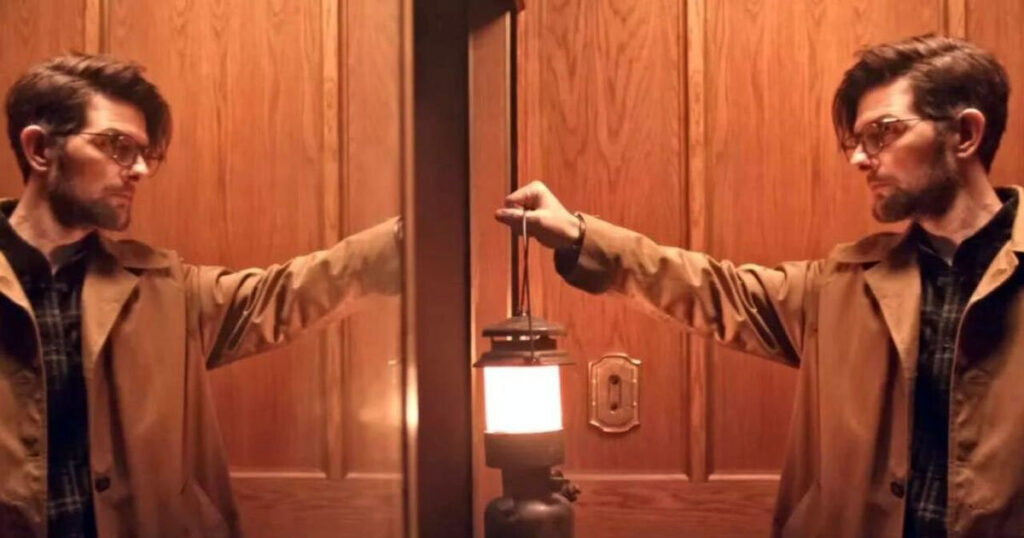
But for those who deeply appreciate atmospheric, patient storytelling, this incredibly deliberate pacing is absolutely a brilliant feature, not a bug. The heavy thematic weight of the story is what ultimately keeps the narrative engine running when the plot slows down. At its absolute core, beneath all the spooky lore and the missing person posters, the movie is not really just about a haunted room or a local witch.
It is a profound, devastating exploration of deep-seated regret, the crushing burden of inescapable personal history, and the elaborate, comforting lies we tell ourselves just to survive the day. Ohm is quite literally carrying the heavy ashes of his past with him in an urn, unable to let go. He is violently forced by the events at the hotel to finally confront his unresolved childhood trauma and his long-buried, suffocating guilt. The literal, physical ghosts haunting the corridors are definitely scary, sure, but it is the metaphorical demons that Ohm wrestles with internally that truly give the narrative its heartbreaking, lasting impact.
Final Verdict on Hokum (2026)
As we finally wrap up this Hokum movie review, it is time to look at the big picture and consolidate the broader cultural reaction. The general consensus across the media landscape and festival circuits has been highly favorable. Critics have spent weeks praising the film’s rare ability to elevate standard, tired horror tropes through exceptionally detailed character work and an absolutely paralyzing, thick atmosphere. Many prominent reviewers have rightly pointed out that it stands head and shoulders above the typical, mainstream jump-scare fests that usually flood theaters in the fall season.
I have to completely agree with the prevailing, positive sentiment, though I’ll add my own summarizing perspective: this film is an absolute, undeniable triumph of mood over mechanics. While the mystery aspect occasionally feels a little clunky and disjointed, and the aggressively slow pacing might alienate the casual weekend popcorn crowd, the sheer, undeniable craftsmanship on display from the entire crew is breathtaking. Adam Scott delivers what might genuinely be a career-best, heartbreaking dramatic performance, and Damian McCarthy proves once again that he is an undisputed master of wringing pure, unadulterated anxiety out of simple, dark spaces. It is a suffocating, beautifully crafted, and emotionally devastating nightmare that will undoubtedly stay with you long after you finally check out of the Bilberry Woods Hotel.