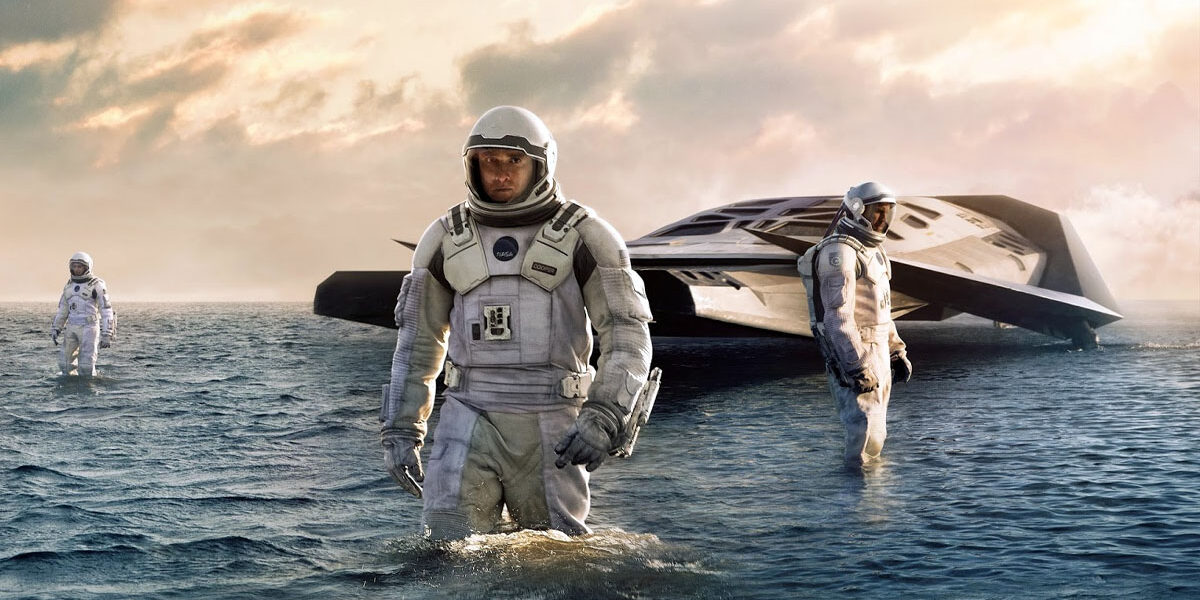
When Christopher Nolan released his breathtaking space epic to the world, audiences were left awe-struck, emotionally drained, and, quite frankly, a little bewildered by the sheer scale of the concepts presented. Even years after its cinematic debut, the search for a comprehensive Interstellar ending explained remains incredibly active. It is a testament to a film that refuses to be simply watched and forgotten; it demands to be pondered, discussed, and analyzed. Today, we are going deep into the heart of Gargantua. We will review the film’s unparalleled commitment to scientific realism, explore the tragic paradoxes of time dilation, break down the complex geometry of the fifth dimension, and finally, uncover the ultimate fate of Amelia Brand.
A Masterpiece of Realistic Sci-Fi: The Ultimate Review
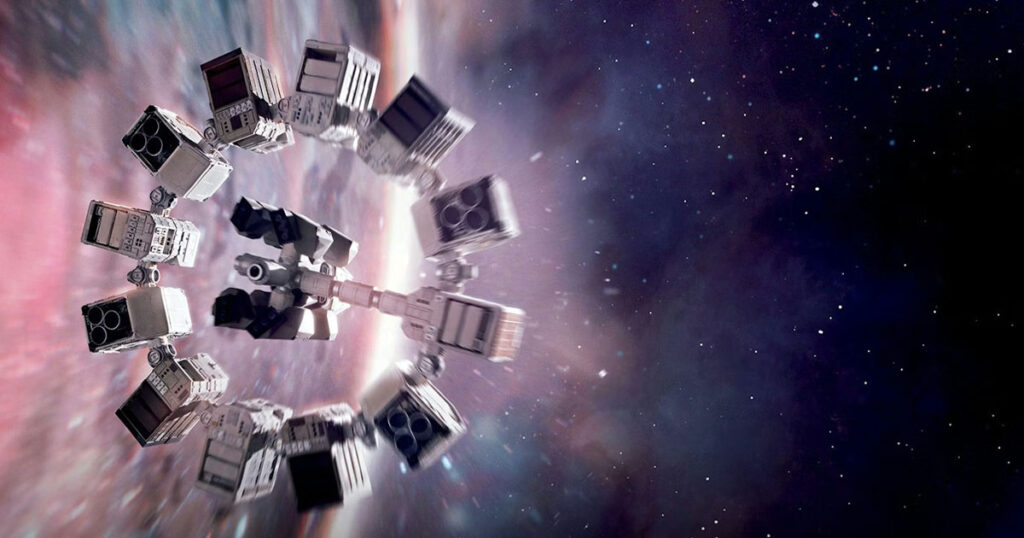
In a cinematic landscape often crowded with laser battles and alien invasions, Interstellar stands as a monolithic achievement in hard science fiction. Christopher Nolan did not just want to make a movie about space; he wanted to make a movie about physics. To achieve this, the production brought on theoretical physicist Kip Thorne (who later won a Nobel Prize) as an executive producer and scientific consultant. This collaboration birthed a cinematic experience that has been widely lauded by the scientific community as one of the most accurate depictions of astrophysics ever put to film.
The visual representation of the black hole, Gargantua, was not just a beautiful VFX asset; it was the result of actual physics equations fed into rendering software. It provided one of the first highly accurate visual simulations of an accretion disk and gravitational lensing—years before the Event Horizon Telescope captured the first real image of a black hole in 2019, which strikingly resembled Nolan’s vision.
Beyond the strict adherence to science, the film is a masterclass in tension and emotional storytelling. Matthew McConaughey delivers a career-defining performance as Cooper, a desperate father forced to choose between the family he loves and the survival of the human species. Supported by Anne Hathaway’s deeply earnest portrayal of Dr. Amelia Brand and Jessica Chastain’s fierce determination as the adult Murph, the human element anchors the mind-bending science. Coupled with Hans Zimmer’s organ-heavy, cathedral-like musical score, which pulses like the ticking of a cosmic clock, Interstellar is a visceral, immersive experience. It is a film that respects the intelligence of its audience, challenging us to grapple with the unfathomable vastness of the universe while keeping us tightly bound to the intimate love between a father and his daughter.
The Agony of Relativity: The Contradiction of Time Dilation
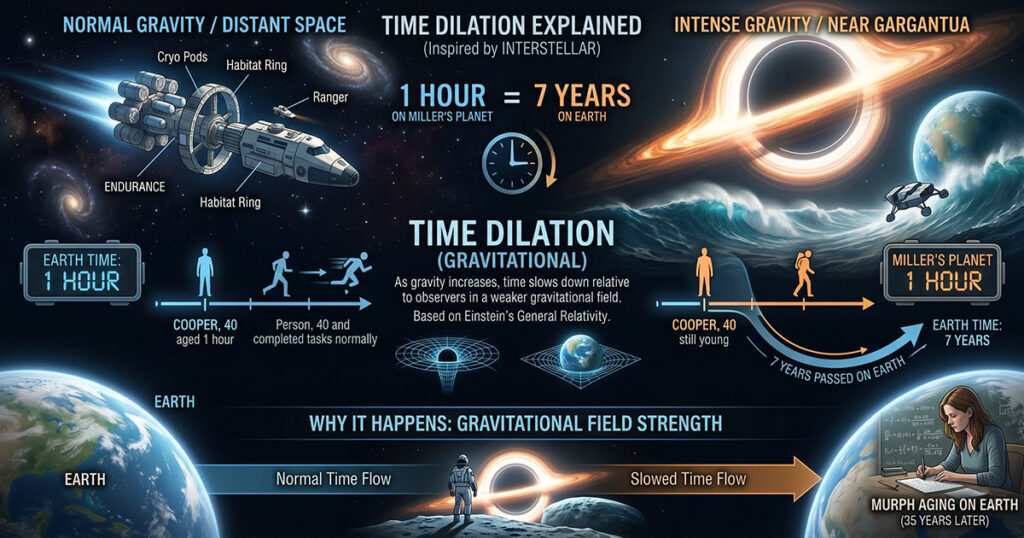
One of the most devastating and brilliant aspects of the film is its exploration of time dilation—a core concept of Einstein’s theory of general relativity. In most sci-fi films, time is a universal constant. In Interstellar, time is an active antagonist, a finite resource that slips through our heroes’ fingers with agonizing speed.
The concept is introduced brutally when the crew lands on Miller’s planet. Because this water-logged world is situated incredibly close to the supermassive black hole Gargantua, the intense gravitational pull warps spacetime to extreme degrees. The rule is simple yet terrifying: one hour on this planet equals seven years on Earth.
This creates a harrowing “time contradiction” for the characters. When a massive, mountain-sized tidal wave forces a delay in their departure, the tension is not just about survival; it is about the cost of seconds. They survive, but the toll is exacted in decades. When Cooper and Brand return to the Endurance, they find their crewmate Romilly visibly aged, having waited twenty-three years in what felt to them like a mere afternoon.
This leads to arguably the most heartbreaking scene in modern cinema: Cooper sitting alone, watching over two decades of video messages from his children. In a matter of minutes, he watches his son grow up, find love, lose a child, and ultimately give up hope on him. He watches his daughter, Murph, reach the exact age he was when he left. Time dilation here isn’t just a cool scientific trick; it is a profound narrative tool that highlights the cruel, indifferent nature of the universe against the fragile, fleeting nature of human life. The physics of relativity becomes the ultimate emotional tragedy.
Beyond the Event Horizon: The 5th Dimension Explained
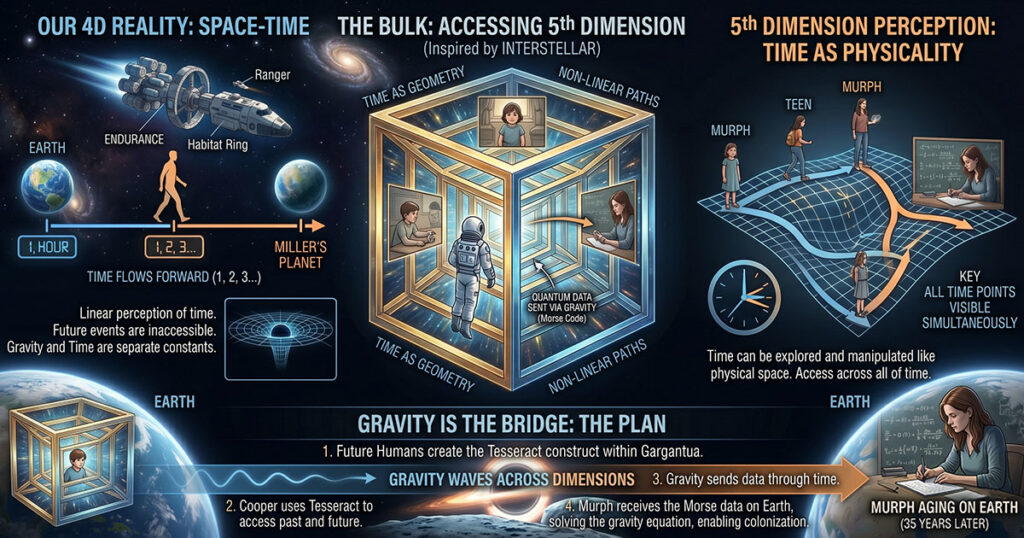
To fully grasp the Interstellar ending explained, we must dive into the most challenging act of the movie: the Tesseract and the fifth dimension. After a desperate maneuver to slingshot Brand toward Edmunds’ planet, Cooper sacrifices himself, dropping his spacecraft into the swirling abyss of Gargantua. Instead of being crushed by infinite gravity, he survives the crossing of the event horizon and ejects into a strange, infinitely repeating, hyper-dimensional space known as the Tesseract.
But what exactly is the 5th dimension in this context?
We humans exist in a three-dimensional world (length, width, and depth) and move linearly through the fourth dimension (time). We cannot move backward or forward in time at will; we are carried by it. Inside the black hole, Cooper is rescued by “They” (the mysterious bulk beings who created the wormhole). However, “They” are not aliens. The film strongly implies that “They” are actually us—humanity from the distant future. Having evolved to exist in five dimensions, these future humans can perceive time not as a flowing river, but as a physical landscape.
The Tesseract is a specialized, 3D interface constructed by these future humans specifically for Cooper. It takes the incomprehensible complexity of the 5th dimension and translates it into a physical space he can understand: the back of his daughter’s bookshelf. In this space, time is represented physically. Every moment in Murph’s bedroom exists simultaneously as an endless corridor of distinct, physical frames.
However, even in the 5th dimension, the rules of the universe apply. Cooper cannot simply punch through the wall and shake hands with his past self. He can only interact through the one force in physics that can traverse across spacetime and dimensions: Gravity.
This is the Eureka moment of the film. Love, which Dr. Brand hypothesized earlier as an actual quantifiable force, is what allows Cooper to find the exact right moment in time. He uses gravity to push books off the shelf (the “ghost” from the beginning of the movie), leaves the coordinates for NASA in the dust, and finally, encodes the crucial quantum data gathered from the black hole into the second hand of the watch he left with Murph.
Interstellar Ending Explained: Closing the Temporal Loop

The climax of the film resolves the massive paradox that has been building since the first frame. Once Cooper transmits the quantum data via Morse code through the ticking watch hand, adult Murph—now a brilliant physicist—realizes her “ghost” was her father all along. With this quantum data, she solves Professor Brand’s equation, unlocking the secret to controlling gravity. This allows humanity to lift massive space stations off the dying Earth, saving the species (Plan A).
With his mission accomplished, the future humans close the Tesseract. The paradox is complete. The temporal loop is closed: Cooper had to leave Earth so he could fall into the black hole, to become the ghost that tells his past self to leave Earth.
Cooper is expelled back out of the wormhole near Saturn, where he is discovered floating in space decades later. He wakes up in a pristine hospital room on “Cooper Station,” a massive cylindrical space habitat orbiting Saturn. He is initially confused, thinking the station is named after him, but is gently corrected: it is named after Murph, the savior of humanity.
He is then taken to see his daughter. Because of the extreme time dilation experienced near the black hole and the Tesseract, Cooper is still physically a man in his 40s. Murph, however, is now an elderly woman on her deathbed, surrounded by her own massive family—a family Cooper does not know. The reunion is brief, bittersweet, and emotionally devastating. Murph has lived a full, rich life without him. She holds his hand and tells him, “No parent should have to watch their own child die. I have my kids here for me now. You go.”
She gives him absolution. His duty to his daughter is done; he kept his promise. But where is he supposed to go?
The Ultimate Question: What is the Fate of Amelia Brand?
This brings us to the final, lingering question of the film: What happened to Dr. Amelia Brand?

Throughout the film, Brand is driven by both her scientific duty and her enduring love for Wolf Edmunds, one of the original astronauts sent through the wormhole years prior. In a pivotal earlier scene, she argues that they should go to Edmunds’ planet instead of Mann’s, theorizing that love might be an artifact of a higher dimension that we can’t consciously comprehend. Cooper dismisses her argument as emotional bias and chooses Mann’s planet—a decision that nearly costs them everything.
The beautiful, poignant irony of the film is that Brand was right. Science and cold logic (represented by Dr. Mann) led to betrayal, death, and an uninhabitable ice rock. Love, the irrational human emotion, pointed toward the only viable home.
In the final montage, as an elderly Murph tells her father to “go,” we see the fate of Amelia Brand. Cooper successfully slingshotted her out of Gargantua’s gravitational pull, sending her alone to Edmunds’ planet. We see her standing on a desert-like but fundamentally habitable world. The air is breathable.
However, she arrives too late to reunite with the man she loved; we see her burying Wolf Edmunds under a pile of stones. Yet, amidst her grief, there is profound hope. She is setting up the “Plan B” colony camp. She unpacks the massive cryogenic pods containing thousands of fertilized human embryos.
Brand’s fate is to be the mother of a new world. She is entirely alone on an alien planet, millions of lightyears from anyone, preparing to incubate and raise the first generation of a new human civilization. She is waiting by the light of a new sun, believing she is the last surviving human in the universe, unaware that Murph solved the equation and that Cooper Station is currently orbiting Saturn.
The movie ends with Cooper, accompanied by the reassembled robot TARS, stealing a small Ranger spacecraft from the station. He engages the thrusters, heading back toward the wormhole. His destination is clear. He is going to Edmunds’ planet. He is going to find Brand, to tell her that humanity survived, and to join her in building the future.
A Synthesis of Science and Soul

Looking back at the monumental achievement that is Interstellar, it is fascinating to see how the general consensus has evolved. Upon its release, some critics argued that the film’s attempt to marry hard, rigorous astrophysics with the abstract, sentimental concept of “love” felt jarring. Some felt the exposition was heavy, while others were overwhelmed by the sheer volume of scientific theory required to keep up with the plot.
However, as time has passed, the cinematic and cultural appreciation for Nolan’s magnum opus has only solidified. The visual effects have not aged a day; the depiction of the black hole remains a gold standard in sci-fi cinema. But more importantly, the film’s emotional core has proven to be its most enduring legacy.
When we synthesize the widespread media critiques with our own deep dive, the ultimate takeaway is this: Interstellar is not just a movie about space travel; it is a profound meditation on the human condition. It takes the coldest, most terrifying aspects of our universe—infinite voids, crushing gravity, and the relentless, unidirectional flow of time—and counters them with the warmest, most irrational human trait we possess. While some may still debate the philosophical validity of love traversing dimensions, the film makes a compelling, emotionally exhausting case that our scientific ambition means nothing without the human connections that drive us. It remains a staggering, beautiful contradiction—a film built on exact mathematics that ultimately proves that humanity’s greatest strength is our immeasurable heart.