When Dark first materialized as Netflix’s debut German-language original, many viewers lazily labeled it a “German Stranger Things.” However, as the shadows lengthened over the rain-drenched forests of Winden, it became abundantly clear that such comparisons were not merely reductive—they were fundamentally incorrect.
Dark is not a nostalgic sci-fi romp; it is a rigorous, sophisticated exploration of quantum physics, determinism, and human tragedy. It represents a massive narrative shift from a standard missing-child mystery to a recursive storytelling achievement that demands your full attention. The “pen and paper” requirement often jokingly cited by viewers isn’t a barrier to entry, but rather the show’s primary charm. Driven by the central philosophical axiom that “the beginning is the end, and the end is the beginning,” the series constructs a brilliant world where four families are locked in an eternal struggle against the very fabric of time itself.
The Four Families of Winden
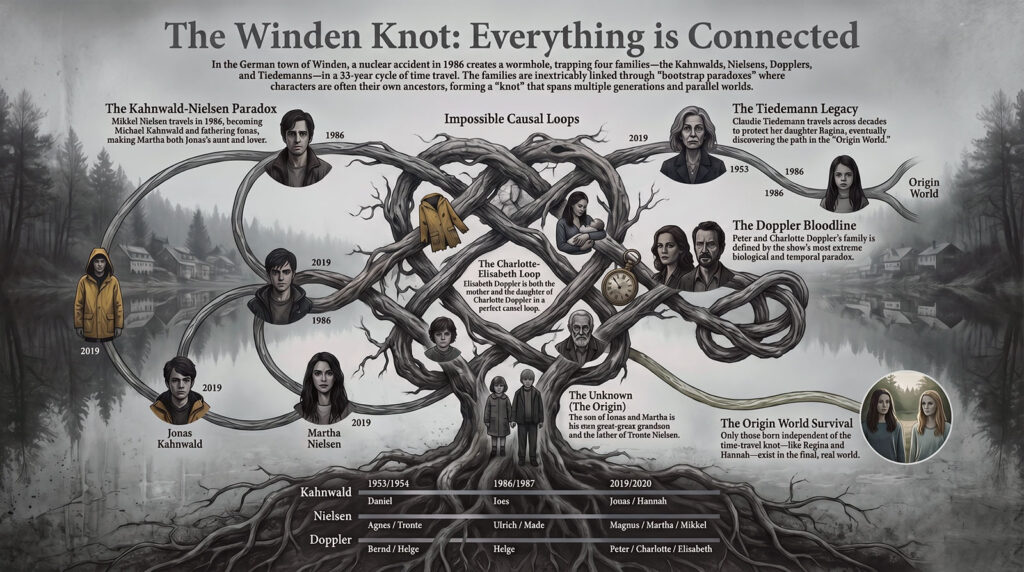
The emotional stakes of Dark are deeply grounded in its four primary families. This is not just a story of neighbors keeping secrets, but a recursive tragedy where family trees collapse in on themselves. The tragedy is quintessentially Winden: Ulrich Nielsen’s desperate search for his missing son, Mikkel, leads him into a past where he inadvertently bullies the boy who will eventually become his son’s father.
- The Kahnwald Family: Anchored by Jonas’s grief following the suicide of his father, Michael (the time-displaced Mikkel Nielsen). The lineage is defined by the manipulative Hannah and the secretive Ines, illustrating how individual trauma fuels the never-ending loop.
- The Nielsen Family: Defined by intergenerational trauma and infidelity. Ulrich and Katharina’s frantic search for Mikkel, alongside Magnus and Martha’s discovery of the truth, forms the show’s visceral heart. Their existence is further complicated by Agnes, the enigmatic matriarch whose presence spans decades.
- The Doppler Family: A foundation built entirely on stolen identities and future-loop secrets. The relationship between Charlotte and Peter is the show’s most profound biological impossibility, while Helge’s dementia serves as a tragic echo of the town’s fractured timeline.
- The Tiedemann Family: The town’s social and industrial spine. Claudia’s transition from a power-plant director to “The White Devil” contrasts heavily with Regina and Aleksander’s struggle to maintain a normal life outside the town’s deterministic shadow.
The immersion of this complex architecture is cemented by a casting feat that defies standard television conventions. The multi-generational portrayals are so physically and behaviorally synchronized that the biological continuity feels absolute.
Casting Architecture: Multi-Generational Portrayals
Credited to : IMDB.com
| Character Name | Actor (Young/Teen) | Actor (Adult/Middle-Aged) | Actor (Old/Adam/Eva) |
|---|---|---|---|
| Jonas Kahnwald | Louis Hofmann | Andreas Pietschmann | Dietrich Hollinderbäumer (Adam) |
| Martha Nielsen | Lisa Vicari | Nina Kronjäger | Barbara Nüsse (Eva) |
| Ulrich Nielsen | Ludger Bökelmann | Oliver Masucci | Winfried Glatzeder |
| Claudia Tiedemann | Gwendolyn Göbel | Julika Jenkins | Lisa Kreuzer |
| Helge Doppler | Tom Philipp | Peter Schneider | Hermann Beyer |
| Noah | Max Schimmelpfennig | Mark Waschke | N/A |
| Aleksander Tiedemann | Béla Gabor Lenz | Peter Benedict | N/A |
| Katharina Nielsen | Nele Trebs | Jördis Triebel | N/A |
Time Machines and Temporal Logistics
Throughout the series, various contraptions serve as the physical anchors for the show’s increasingly complex temporal logistics, acting as connective tissue across three centuries of struggle.
- The Passage: The primary wormhole in the Winden caves, a byproduct of the 1986 incident, facilitating travel in fixed 33-year increments.
- The Chair Machine: A brutal, failed prototype in the bunker. It served as a lethal experiment on children, whose eyes were burned by unrefined energy.
- Tannhaus’s Clockwork Device: The iconic suitcase machine, requiring a stabilized God Particle and Cesium to operate.
- The God Particle: A shifting sphere of stabilized dark matter that allows travel to any point in time, finally breaking free from the 33-year constraint.
- The Sphere Machine: The mechanical manifestation of Eva’s philosophy. Unlike Adam’s cumbersome devices, this golden spherical tool allows for world-jumping, marking a strategic shift in Season 3 toward a multiverse struggle.
- The Origin Machine: The massive apparatus built by H.G. Tannhaus in the Origin World (1986), which, in his desperate attempt to save his family, accidentally fractured one world into two.
Deconstructing the Causal Knot: The Information Paradox
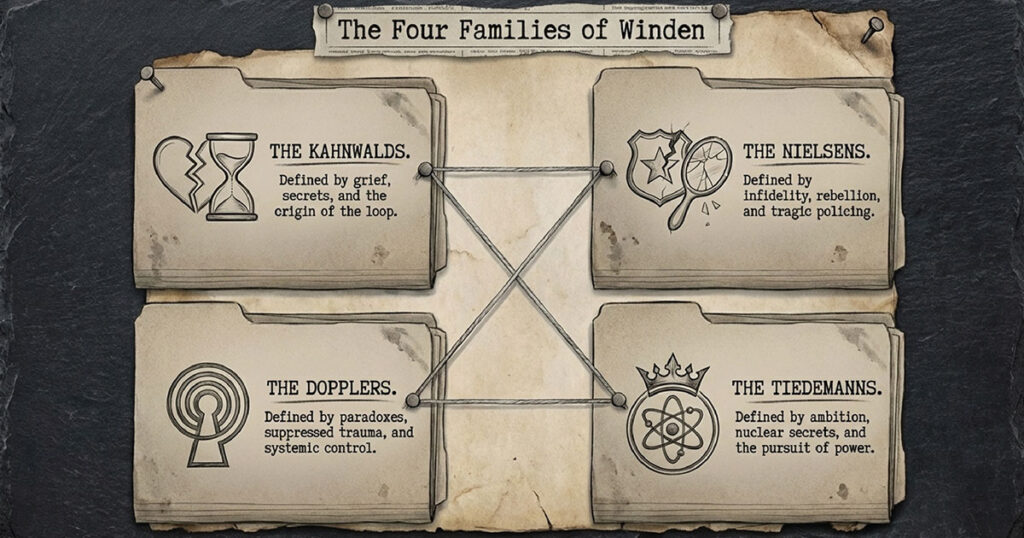
The structural integrity of Dark rests heavily upon the “Information Paradox.” This logic posits that objects or biological entities can exist within a loop without a true point of origin.
- The Elisabeth/Charlotte Loop: The show’s most mind-bending biological disaster. Elisabeth Doppler gives birth to Charlotte (with Noah), and Charlotte gives birth to Elisabeth (with Peter). They are mother and daughter to one another, existing as a genetic loop with no external origin.
- The Jonas/Michael Loop: Jonas is effectively the architect of his own conception, leading young Mikkel into the caves in 2019 to ensure he travels back to 1986 and becomes Michael Kahnwald.
- The Unknown: The lip-clefted son of Jonas (Adam’s World) and Martha (Eva’s World). He is the physical bridge between realities, fathering Tronte Nielsen in both worlds, making him his own great-great-grandson.
- The Book and Blueprints: A Journey Through Time and the suitcase machine blueprints have no original author. They are continuously copied from future versions, existing as pure information within the loop.
A Century of Winden (1888–2053)
To truly appreciate the scale of this narrative, one must view the timeline chronologically, tracking Winden’s grim evolution:
- 1888–1921: The founding of Sic Mundus. We witness Jonas’s gradual disfigurement into Adam and his transition from holding out hope to desiring the absolute destruction of the origin.
- 1953–1954: The power plant’s genesis. Gretchen the dog disappears, Ulrich is imprisoned, and the first tendrils of the Tiedemann/Doppler secrets take root.
- 1986–1987: The pivot point. The passage opens, Mads Nielsen is taken, and Mikkel arrives from the future, beginning the Kahnwald lineage.
- 2019–2020: The “modern” cycle where the loop begins to fray, ultimately culminating in the devastating 2020 apocalypse.
- 2052–2053: The post-apocalyptic wasteland where Elisabeth Doppler leads the survivors, and the God Particle remains hidden in the plant ruins.
Season 3 introduces “Eva’s World”—a mirror reality with a “Jonas-shaped hole.” Because Mikkel never traveled back in this timeline, Jonas does not exist. Consequently, Ulrich leaves Katharina for a pregnant Hannah, and Aleksander is blackmailed by Hannah for a murder committed 33 years prior, rather than just identity theft.
The Triquetra and the Perfect Ending
Concluding an ontological labyrinth of this magnitude is a Herculean challenge, yet the finale delivers an incredibly satisfying payoff. It reveals that the endless war between Adam (destruction) and Eva (preservation) was merely a byproduct of the Triquetra’s third dimension: the Origin World.
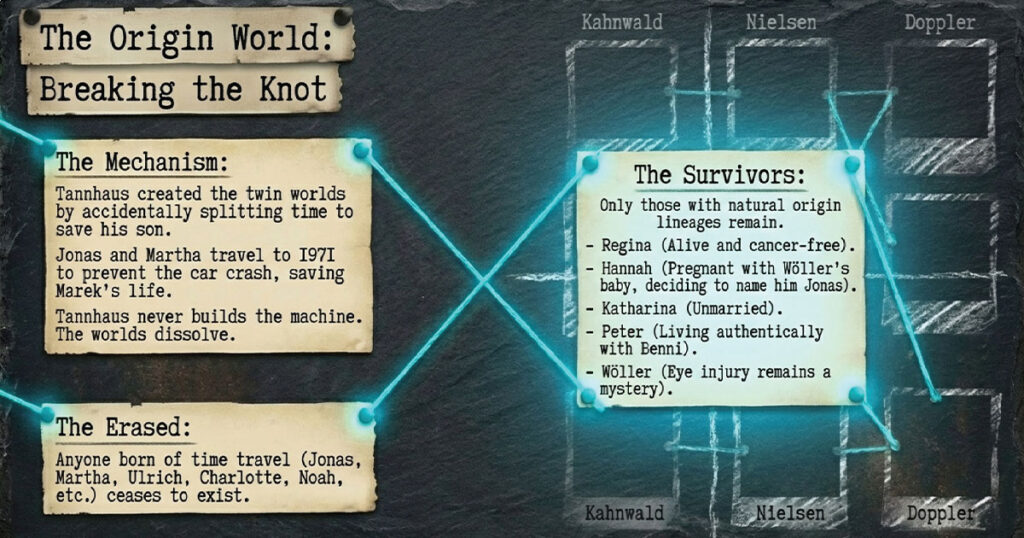
The ending is ultimately a selfless choice. By realizing that H.G. Tannhaus’s 1971 grief—the tragic loss of his son Marek, daughter-in-law Sonja, and baby Charlotte—is the root cause of the fracture, Jonas and Martha accept their own non-existence. They travel to the Origin World to prevent the car accident, beautifully untying the causal knot.
The final dinner party serves as a ghostly residual of the loops. Characters who were not “bootstrapped” into existence by time travel (Regina, Hannah, Katharina, Peter, Benni, and Wöller) remain. Hannah’s yellow coat and her sudden instinct to name her unborn son “Jonas” suggest that while the fractured worlds vanished, the echoes of their struggle remain as a lingering déjà vu.
Lingering Secrets and Narrative Voids
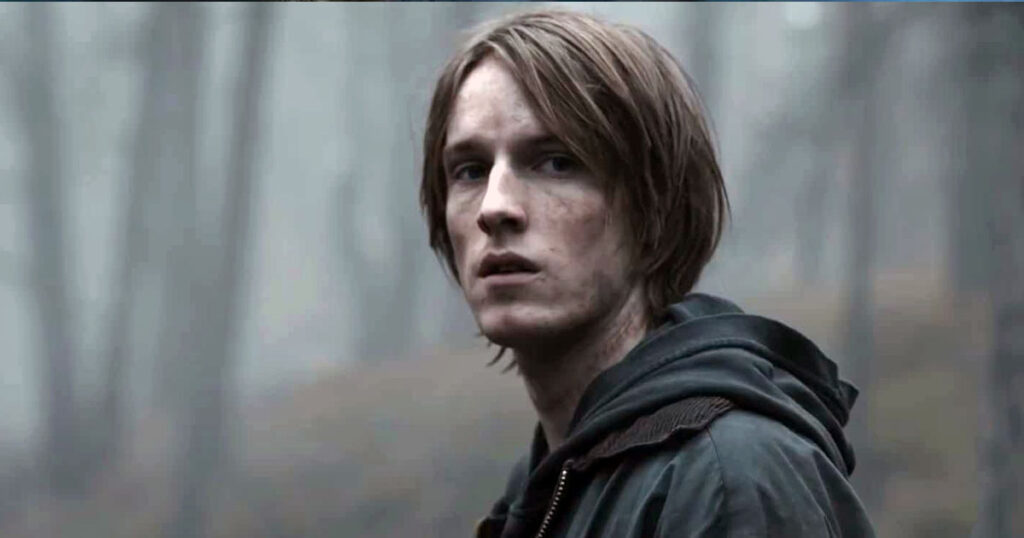
Even a finale this definitive leaves behind a bit of “narrative residue” that fuels fan theories to this day. These aren’t plot holes, but rather intentional textures within the architecture:
- Wöller’s Eye/Arm: A recurring gag that reinforces the show’s dark humor. His injury (an eye in Adam’s world, an arm in Eva’s) remains a cut-off secret even in the Origin World.
- Regina’s Father: While the loop heavily suggested Tronte Nielsen, the finale strongly implies Bernd Doppler is her true father, subtly reframing Claudia’s history.
- The Tip-Off: The mystery of who alerted Investigator Clausen to Aleksander’s identity is resolved by the Unknown, who deliberately triggered the search of the power plant to ensure the apocalypse happened.
- Agnes’s Disappearance: Her fate after betraying Noah remains a narrative void, perfectly reflecting the cold, disposable nature of the Sic Mundus society.
These minor mysteries do not diminish the show’s masterpiece status. Rather, they serve as a final, haunting reminder of the show’s iconic quote: “What we know is a drop, what we don’t know is an ocean.” Dark stands as a monumental achievement in narrative architecture—a series that proves even within the most rigid determinism, there is room for one final, world-saving choice.