
In this comprehensive Ladies First Netflix review, we have to address the elephant in the streaming room: sometimes, a high-concept premise is simply not enough to carry an entire feature film. Arriving on our screens with a stacked cast and a premise that promises biting social satire, Ladies First attempts to tackle the heavy realities of patriarchy through the lens of a lighthearted, alternate-universe comedy. Directed by Thea Sharrock and acting as an English-language remake of the 2018 French film I Am Not an Easy Man, the movie flips the script on gender dynamics. But does flipping the script actually result in a compelling narrative, or does it merely expose the limitations of a one-joke premise? Let’s break down why this highly anticipated release struggles to find its footing in the modern comedy landscape.
The Setup: A Chauvinist’s Matriarchal Nightmare

The narrative thrust of Ladies First centers around Damien Sachs, played by Sacha Baron Cohen. Damien is the quintessential arrogant, charismatic, and deeply misogynistic advertising executive. He is a man accustomed to having the world handed to him on a silver platter, effortlessly gliding through corporate promotions and casual flings with a profound lack of self-awareness. He is primed to take over as CEO from his buddy Fred (veteran actor Charles Dance), reveling in a system built entirely for his benefit.
That is, until a swift bump to the head knocks him unconscious. When Damien awakens, the rules of reality have been drastically rewritten. He finds himself in a parallel universe where women hold all the cards. They dominate the boardrooms, dictate politics, and aggressively pursue men who are now relegated to subordinate, aesthetic-focused roles. In this inverted reality, Damien is stripped of his privilege. He is objectified, talked over, and sexually harassed by the very women he once demeaned.
His primary antagonist in this new world is Alex Fox (Rosamund Pike), a fierce, unapologetic executive who embodies the ruthless alpha-energy Damien used to possess. What follows is a battle of the sexes where the battleground has been entirely terraformed, forcing Damien to navigate a society explicitly designed to keep him down.
Sacha Baron Cohen and Rosamund Pike: A Tale of Two Performances
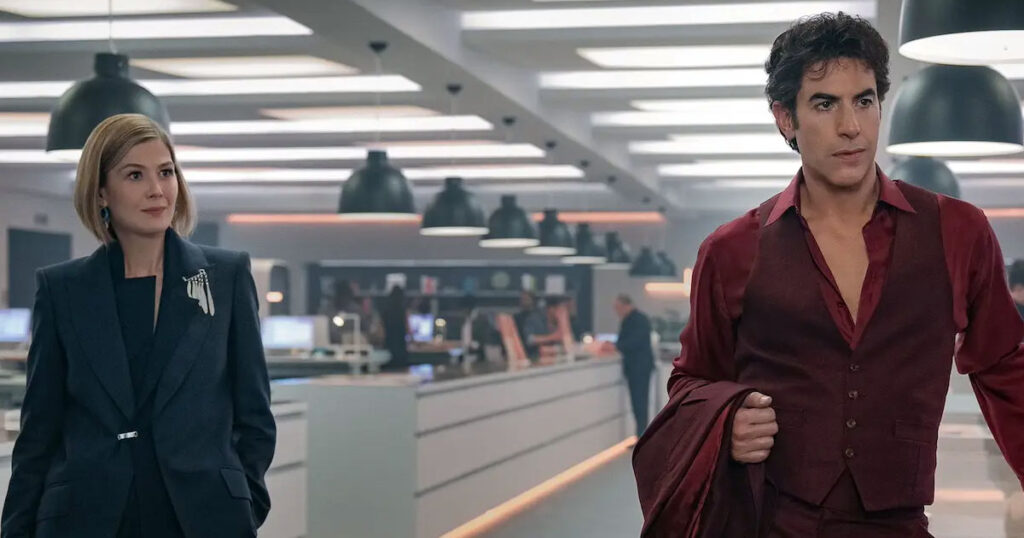
If there is a fundamental disconnect in Ladies First, it begins with the casting. Sacha Baron Cohen is an undeniably brilliant comedic force, a master of disguise and guerrilla satire (Borat, Who Is America?). However, stepping into the shoes of a traditional leading man in a high-concept rom-com feels like trying to fit a square peg into a round hole. Damien Sachs requires a certain level of suave, underlying charm so the audience can eventually root for his redemption. Cohen plays the misogyny well, but when the script demands vulnerability or genuine romantic tension, his performance falls unexpectedly flat. He feels jarringly out of place, as if he wandered off the set of a much darker, much more cynical movie.
On the opposite end of the spectrum is Rosamund Pike, who single-handedly elevates every scene she is in. Whether she is playing the patronized token female in the “real” world or the terrifyingly effective apex predator in the matriarchal universe, Pike is magnetic. She leans into the corporate sleaze of her alternate-reality character with a delectable sharpness, proving yet again that she is one of the most versatile actors working today. Her ability to navigate the absurdities of the script with a straight face is commendable. Sadly, her immense talent highlights the glaring lack of chemistry between her and Cohen. It is a comedic dance where one partner is executing flawless choreography while the other is stumbling over their own feet.
The supporting cast, including heavyweights like Emily Mortimer, Richard E. Grant, and Fiona Shaw, are largely wasted on sight gags and one-dimensional caricatures. Watching incredibly talented actors perform cheap, repetitive jokes—like Fiona Shaw aggressively mimicking toxic male sexuality—might hold bizarre novelty value for a minute, but it quickly devolves into second-hand embarrassment.
Shallow World-Building in a Post-Barbie Era

The fatal flaw of Ladies First lies in its staggeringly uninspired writing. Adapting a foreign film is always tricky, but screenwriters Natalie Krinsky, Cinco Paul, and Katie Silberman seem to have taken the laziest possible route. The entirety of the world-building relies on a rudimentary “find and replace” method.
Instead of asking how a society ruled by women for millennia might actually look, function, or develop its own unique flaws, the film simply pastes male toxicity onto female characters. We get surface-level visual gags: “Five Guys” becomes “Five Gals,” “Burger King” is “Burger Queen,” and religious figures say “A-women” instead of “Amen.” It feels like a thought experiment drafted by a middle schooler.
In a cinematic era that recently gave us the nuanced, razor-sharp gender commentary of Barbie, Ladies First feels painfully dated. It echoes the simplistic structure of early-2000s comedies like What Women Want, but without the situational charm. The movie repeatedly hammers the audience over the head with its central thesis—that sexism is bad—without ever offering anything new or insightful to the conversation. It mistakes a flipped paradigm for actual cleverness, assuming that the sheer sight of women acting like frat boys is enough to sustain a 90-minute feature. It is not.
The Direction: A Clash of Comedy and Morality

Director Thea Sharrock (Wicked Little Letters) struggles to balance the film’s inherently conflicting tones. On one hand, Ladies First desperately wants to be a breezy, romantic comedy. On the other hand, it is dealing with sobering, real-world issues of systemic oppression, workplace harassment, and gender inequality.
When Damien experiences blatant sexual harassment in the alternate universe, the film attempts to play his trauma for laughs. It creates an incredibly uncomfortable viewing experience. We are asked to chuckle at a man being degraded to teach him a lesson, which ultimately undercuts the severity of the issue the movie claims to care about. You cannot effectively skewer institutionalized misogyny while simultaneously relying on the exact same regressive tropes to generate your humor. The cinematography reflects this disjointedness; the corporate environments are shot with a clinical, icy coldness that feels completely at odds with the wacky, slapstick elements Cohen attempts to inject into his physical performance.
Did the Script Need Flipping?
When synthesizing the broader critical reception with the actual viewing experience, it becomes clear why Ladies First is currently sitting with abysmal ratings across the board. The general consensus from media outlets is that the film is a repetitive, one-joke misfire, and it is hard to disagree.
Ultimately, Ladies First is a movie that severely underestimates its audience. It operates under the assumption that the concept of gender inequality is a brand-new discovery that needs to be explained through a kindergarten-level morality play. It preaches to the choir while simultaneously insulting their intelligence. While Rosamund Pike delivers a performance that deserves to be parachuted into a much better film, her efforts cannot save a sinking ship built on shallow writing and a fundamental misunderstanding of modern satire.
If you are looking for a profound exploration of gender dynamics, or even just a solid weekend laugh, you are better off looking elsewhere. Ladies First opens the door for a compelling conversation, only to immediately slam it in its own face.