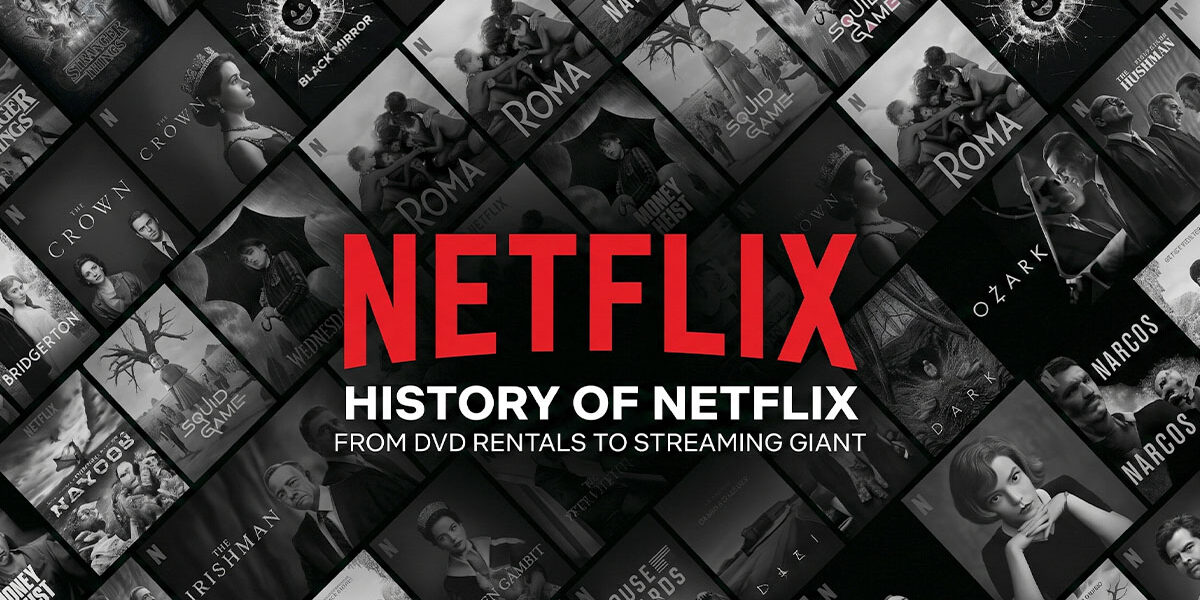
When we look at the modern entertainment landscape, it is impossible to ignore the seismic shift caused by a single company. The history of Netflix is not just a corporate timeline; it is the definitive story of how consumer behavior, technology, and Hollywood collided to forever alter the way we consume narratives. What began as a quirky alternative to driving to a local video store has transformed into a cultural juggernaut that dictates global conversations, creates international superstars overnight, and forces legacy media empires to fundamentally restructure their century-old business models.
To truly understand how we arrived at an era where “Netflix and chill” is a recognized idiom and binge-watching is a weekend norm, we have to rewind the tape to a time when physical media ruled the world.
The Red Envelope Era: A Tale of Late Fees and Logistics (1997-2006)
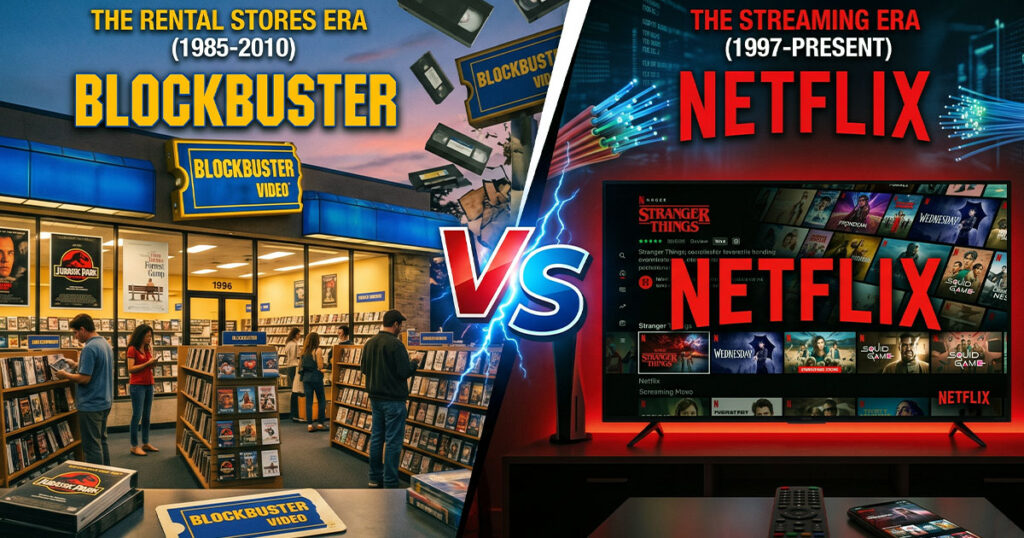
The origin story of Netflix is often wrapped in a neat, mythological bow: Reed Hastings was furious about a $40 late fee for a VHS copy of Apollo 13 at Blockbuster, which sparked a revolutionary idea. While this narrative makes for a fantastic elevator pitch, the reality—driven heavily by co-founder Marc Randolph—was rooted in deep mathematical logistics and the emerging power of the internet.
Founded in August 1997 in Scotts Valley, California, Netflix didn’t start with streaming; bandwidth simply didn’t allow it. Instead, they banked on a brand-new, lightweight technology called the DVD. Hastings and Randolph tested their concept by mailing a compact disc to Hastings’ house in Santa Cruz. When it arrived perfectly intact for the cost of a single postage stamp, the business model was validated.
Initially, Netflix operated much like a traditional rental store but via the web. You paid per rental. However, the true stroke of genius arrived in 1999 with the introduction of the subscription model. For a flat monthly fee, customers could rent unlimited DVDs without due dates, shipping charges, or the dreaded late fees. This flat-rate model was a psychological masterstroke. It removed the friction of penalty-based rentals and built immense customer loyalty.
By 2000, Netflix was growing but bleeding cash. In a now-infamous meeting, Hastings and Randolph offered to sell the company to Blockbuster for a mere $50 million. Blockbuster’s executives reportedly laughed them out of the room. It stands today as one of the most catastrophic business miscalculations in history. Netflix would go public in 2002, slowly but surely eating away at physical rental chains through sheer convenience and a vastly superior recommendation algorithm known as Cinematch.
The Paradigm Shift: Pressing “Play” on Streaming (2007-2012)

The year 2007 was a watershed moment. While their DVD-by-mail business was booming, delivering its billionth DVD, Hastings knew that shipping plastic discs was a transitional business. The future was in the wires. Netflix introduced “Watch Now,” a feature allowing subscribers to instantly stream a limited catalog of movies and television shows directly to their computers.
Initially, the streaming catalog was abysmal—mostly older, forgotten films and B-movies, as studios refused to license their premium content. However, the technology was undeniably magical. As internet speeds increased and Netflix partnered with consumer electronics companies to get their app onto gaming consoles (like the Xbox 360 and PS3), Blu-ray players, and eventually smart TVs, the momentum became unstoppable.
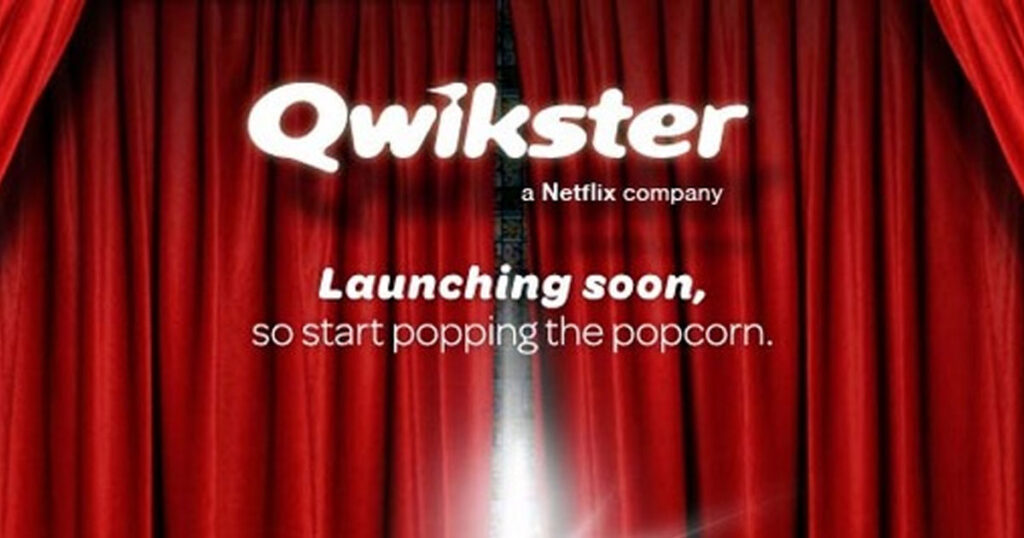
Yet, this era wasn’t without its massive blunders. In 2011, attempting to forcefully separate the legacy DVD business from the streaming future, Hastings announced “Qwikster.” The plan was to split Netflix into two distinct websites and billing structures. The backlash was immediate, furious, and highly publicized. Millions of subscribers canceled, and the stock plummeted. Hastings quickly reversed the decision. In hindsight, while the execution was a PR disaster, the strategic vision was entirely correct: streaming needed to be untethered from the physical past to scale globally.
The Creative Gamble: Becoming the Studio (2013-2017)

As streaming gained traction, a dangerous realization hit the Netflix boardroom in Los Gatos: they were entirely dependent on other studios for their product. Traditional networks like NBC, CBS, and Disney were happy to take Netflix’s licensing money at first, treating the platform as a secondary syndication window. But as Netflix’s subscriber base swelled, the studios realized they were arming their greatest enemy. The cost to license shows skyrocketed.
Netflix’s solution was audacious. If they couldn’t rent the content, they would own it.
In 2013, Netflix shattered the television industry’s traditional pilot system. They outbid HBO and AMC for a political thriller called House of Cards, committing a staggering $100 million for two full seasons sight unseen. They didn’t just release it; they dropped all 13 episodes on the exact same day. This move single-handedly birthed the modern “binge-watching” culture.
The success of House of Cards was quickly followed by Orange Is the New Black, proving that their initial hit wasn’t a fluke. Netflix began leveraging its massive mountain of user data—knowing exactly when users paused, skipped, or stopped watching—to greenlight projects with a terrifying degree of calculated confidence. They weren’t just a distributor anymore; they were a premier Hollywood studio, attracting A-list directors and actors with promises of creative freedom and massive paychecks.
Cultural Juggernauts: Defining the Global Zeitgeist
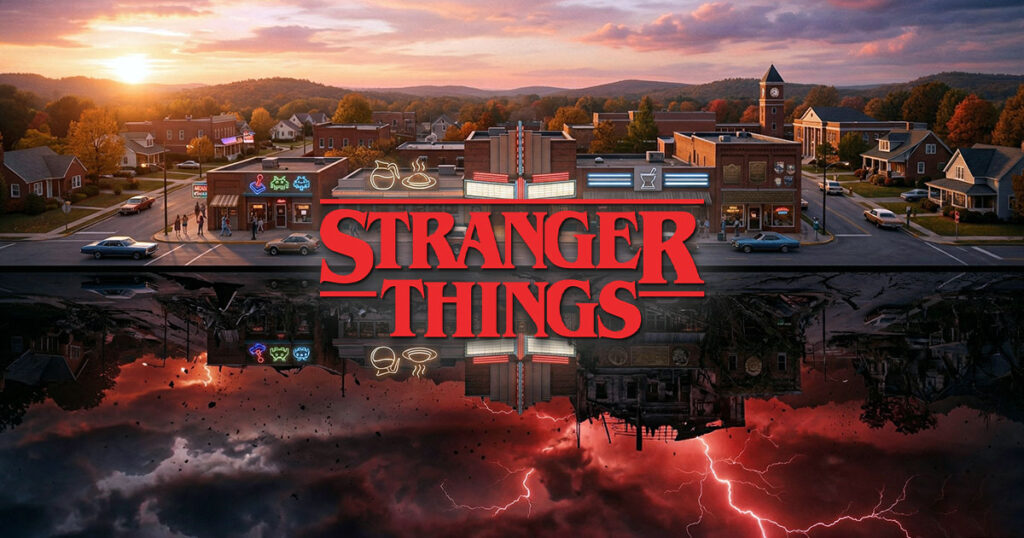
It wasn’t enough to simply produce high-quality content; Netflix began manufacturing global obsessions. The mid-to-late 2010s saw the platform transition from a critical darling into a relentless pop-culture factory. Nothing exemplified this better than Stranger Things. This nostalgic sci-fi horror blend didn’t just attract viewers—it resurrected 1980s aesthetics, catapulted Kate Bush back to the top of the Billboard charts decades after her prime, and turned its young cast into instant global icons.
Meanwhile, The Crown proved that Netflix could execute historical prestige drama with a lavish budget and meticulous detail that rivaled, and arguably surpassed, legacy networks like HBO and the BBC. When Shonda Rhimes’ Bridgerton reimagined the Regency era with a modern twist, it shattered viewership records, only to be chased by the macabre brilliance of Tim Burton’s Wednesday. These weren’t just television shows; they were mandatory cultural flashpoints. Audiences weren’t merely watching; they were discussing, meming, and obsessing over these narratives simultaneously across the globe. This era solidified the “Netflix Bump”—a phenomenon where any song, fashion trend, or actor featured in a hit original was instantly launched into the stratosphere of mainstream relevance.
Global Domination and Bridging Borders (2018-2021)
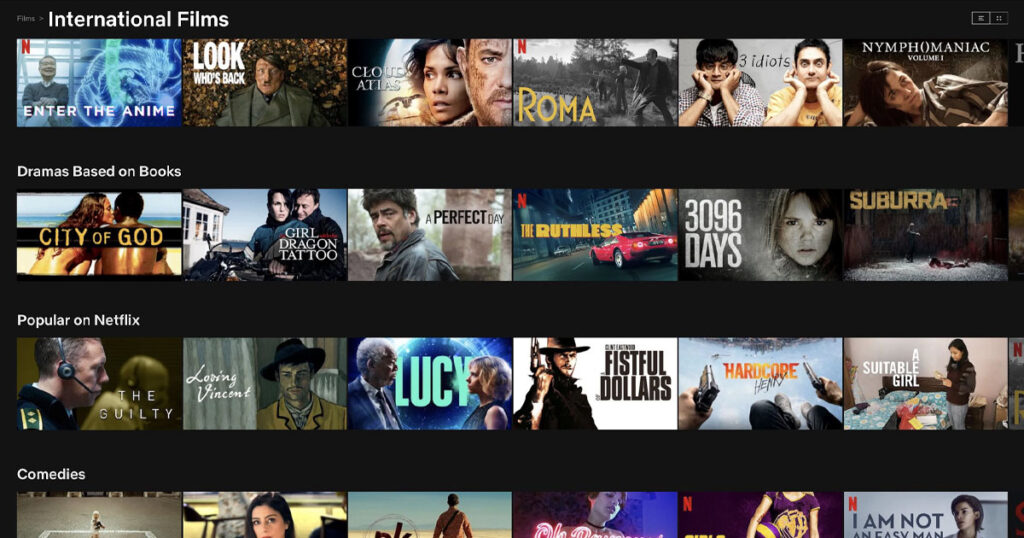
Having conquered North America, Netflix set its sights on the rest of the map. The company embarked on a massive global expansion, launching in over 130 new countries simultaneously in 2016. But rather than just exporting American content, Netflix did something culturally revolutionary: they began heavily investing in local-language originals.
Shows like Germany’s Dark, Spain’s Money Heist (La Casa de Papel), and eventually South Korea’s Squid Game shattered the long-held Hollywood belief that audiences wouldn’t read subtitles. Netflix’s localized dubbing and subtitling infrastructure turned regional hits into massive, synchronous global phenomena. Squid Game didn’t just perform well; it became the most-watched series in the platform’s history, proving that great storytelling transcends language barriers.
During this period, the COVID-19 pandemic hit. As the world went into lockdown, Netflix became a primary source of global comfort and entertainment. Subscriber numbers surged to unprecedented heights. Shows like Tiger King became global shared experiences in an otherwise isolated world. Furthermore, Netflix aggressively chased prestige, spending millions on Oscar campaigns for films like Alfonso Cuarón’s Roma and Martin Scorsese’s The Irishman, forcing the traditional film academy to recognize streaming as a legitimate, high-art medium.
The Streaming Wars: The Empire Strikes Back
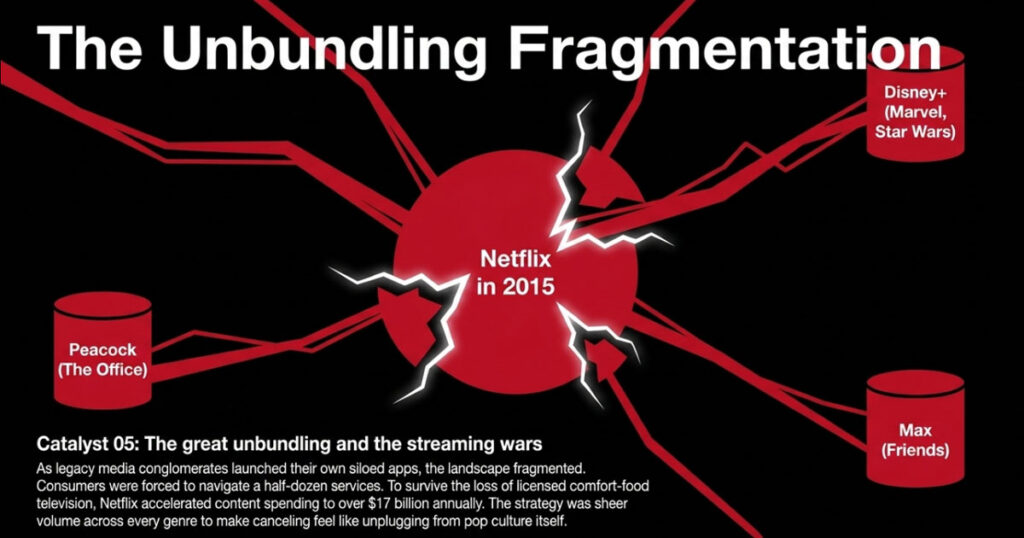
Success breeds imitation. By the late 2010s and early 2020s, the legacy media conglomerates finally woke up from their slumber. The “Great Unbundling” of cable television had arrived. Disney pulled its massive catalog of Marvel, Star Wars, and Pixar films to launch Disney+. WarnerMedia clawed back Friends to build HBO Max (now just Max). NBCUniversal took back The Office for Peacock.
Netflix suddenly found itself in the brutally competitive “Streaming Wars.” The landscape became fragmented. Consumers, once enjoying all their favorite shows for $10 a month on a single app, were now expected to subscribe to half a dozen different services.
To combat the loss of licensed comfort-food television, Netflix accelerated its content spend to dizzying heights—routinely crossing $17 billion annually. The strategy was sheer volume: create so much content across every conceivable genre (reality TV, stand-up comedy, anime, true crime documentaries, big-budget action films) that canceling a subscription felt like unplugging from pop culture itself. However, this strategy also led to criticism regarding quality control, with audiences noting a “throw everything at the wall and see what sticks” approach that resulted in frequent, unceremonious cancellations of fan-favorite shows after just one season.
The Great Correction: Ads, Passwords, and Profitability (2022-2024)
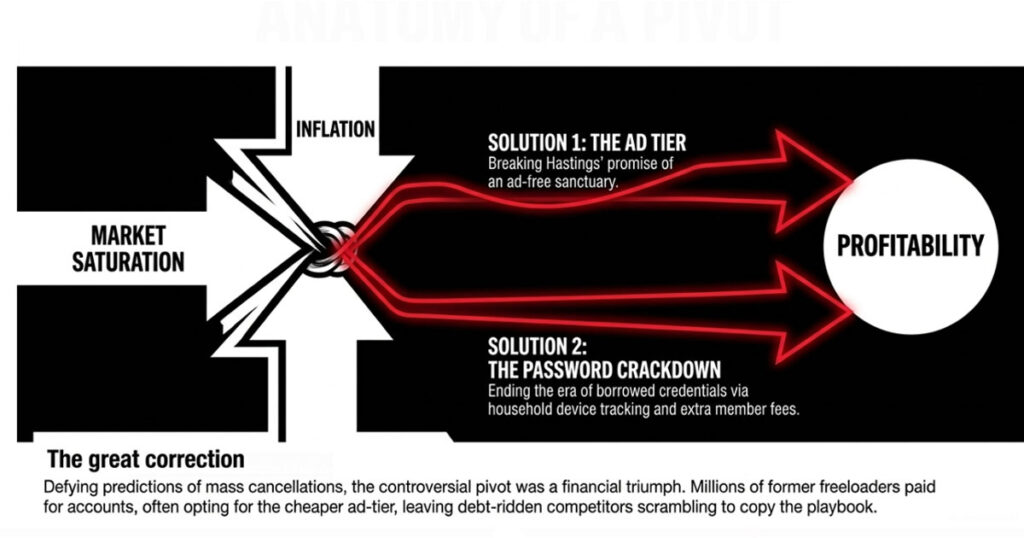
The fairy tale of infinite growth hit a brick wall in early 2022. For the first time in a decade, Netflix reported a loss in subscribers. Wall Street panicked, wiping billions off the company’s market cap overnight. The streaming industry had reached market saturation in key territories, and inflation was forcing consumers to tighten their belts.
Netflix had to pivot from prioritizing subscriber growth at all costs to prioritizing actual profitability. They made two highly controversial decisions that ultimately saved their bottom line.
First, they broke a long-standing promise by introducing a cheaper, ad-supported tier. After years of Hastings famously declaring Netflix would be an ad-free sanctuary, the financial reality demanded change. Second, they declared war on password sharing. For years, Netflix turned a blind eye—even playfully encouraging it on social media—as millions of households used borrowed credentials. By implementing strict household device tracking and charging fees for “extra members,” the internet predicted mass cancellations.
Instead, the exact opposite happened. The crackdown was a massive financial triumph. Millions of former “freeloaders” opted to pay for their own accounts, particularly on the new, cheaper ad-tier. Netflix emerged from the 2022 crisis leaner, far more profitable, and leaving its debt-ridden streaming competitors scrambling to copy their playbook.
Beyond the Screen: Gaming, Live Events, and New Horizons
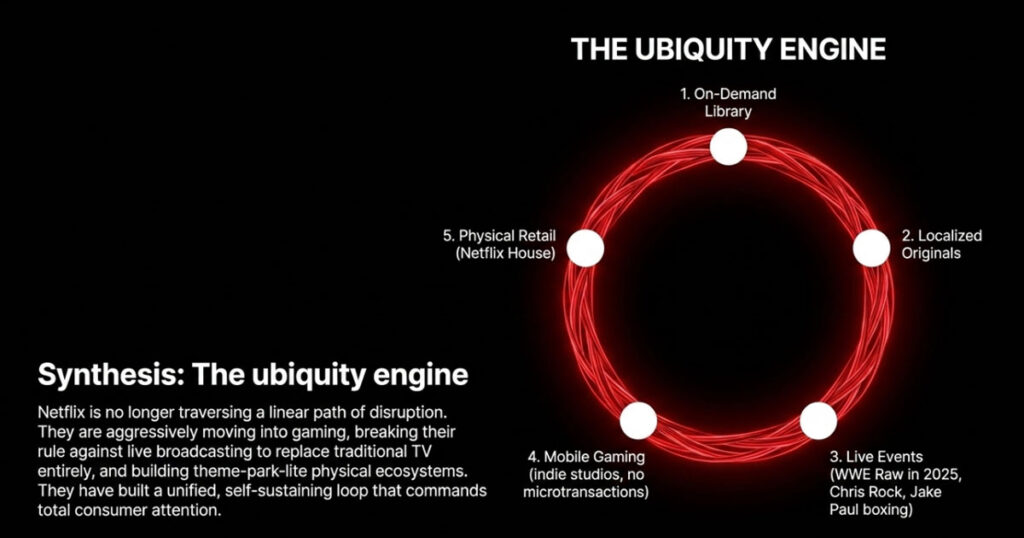
Never content to remain stagnant, Netflix is currently rewriting its own DNA once again. Recognizing that video games compete for the same screen time as movies, Netflix aggressively moved into the mobile gaming space. By acquiring indie studios and offering games within their app free of microtransactions, they are slowly building a Trojan horse into the gaming industry.
More significantly, Netflix has broken its long-held rule against live broadcasting. From live stand-up specials with Chris Rock to massive, highly publicized sporting events like the Jake Paul vs. Mike Tyson boxing match, the platform is testing the waters of real-time event viewing. Their staggering multi-billion dollar deal to become the exclusive home of WWE Raw starting in 2025 signals a definitive shift. They are no longer just an on-demand library; they are aiming to replace traditional broadcast television entirely.
They are also stepping into the physical realm. With the announcement of “Netflix House”—permanent immersive retail, dining, and experiential venues—the company is attempting to build theme-park-lite ecosystems around their proprietary IP, much like Disney has done for decades.
The Future of Netflix: The New Establishment
When looking at the trajectory of Netflix, one thing becomes abundantly clear: the company is no longer the scrappy disruptor from Silicon Valley fighting against the Hollywood machine. Today, Netflix is the machine.
Looking forward, the future of Netflix isn’t just about outspending rivals on prestige dramas; it’s about ubiquity. They have successfully transitioned from a tech company distributing media into a full-fledged global lifestyle brand. The challenges ahead are significant—battling AI-generated content fatigue, managing the ballooning costs of production, and keeping diverse global audiences engaged in an increasingly fragmented digital world.
Yet, as industry analysts and media critics observe, Netflix possesses a unique agility that legacy studios lack. They are ruthless in their data analysis and unafraid to kill their darlings if the math demands it. Ultimately, the future of Netflix reflects the future of entertainment itself: a continuous, algorithmically tuned loop of globalized culture, where the boundaries between television, cinema, gaming, and live events completely dissolve into a single, ever-present red ‘N’ on our screens. They didn’t just change how we watch; they changed how the world tells its stories.