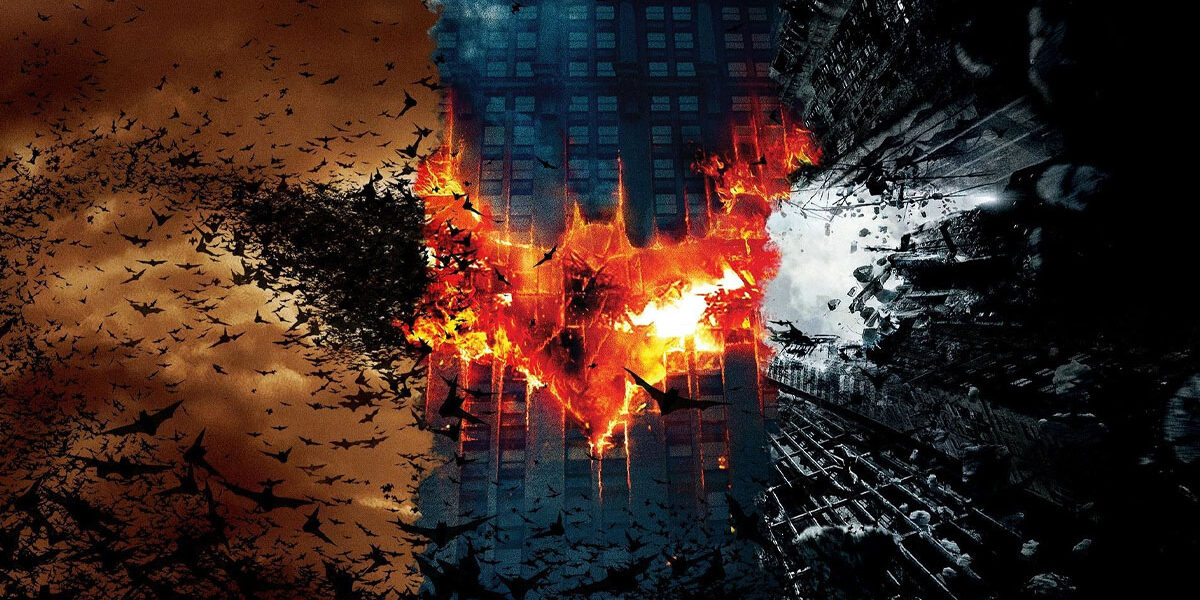
When the cinematic landscape of the summer of 2008 was violently disrupted by the release of Christopher Nolan’s magnum opus, few critics, audiences, or studio executives could have predicted the sheer seismic shift it would cause in Hollywood. To embark on a comprehensive The Dark Knight analysis is to dissect not just a comic book adaptation, but a sprawling, Shakespearean crime epic that fundamentally altered our expectations of what blockbuster cinema could and should be. More than a decade and a half later, it remains the absolute gold standard, the monolithic achievement against which all subsequent superhero films are relentlessly judged—and usually found wanting.
But why? What is it about this specific confluence of script, brilliant casting, transcendent performance, harrowing score, and visionary direction that elevated a movie about a billionaire trauma victim dressed as a bat into the realm of high art and profound philosophical discourse? It is not merely the absence of CGI-heavy third-act skybeams, nor is it simply Heath Ledger’s legendary, posthumously Oscar-winning performance. It is the uncompromising, often deeply uncomfortable way Christopher Nolan forces an inherently ridiculous pulp concept to confront the darkest, most realistic facets of human nature, systemic corruption, morality, and deeply rooted post-9/11 societal anxieties.
This essay will dissect The Dark Knight across multiple dimensions, exploring how it deconstructs the traditional hero’s journey, elevates the cinematic villain to an agent of pure philosophical terror, and utilizes the fabric of a massive blockbuster to ask devastating questions about the price of order in a chaotic world.
Deconstructing the Genre: A Grounded Crime Saga in a Living City
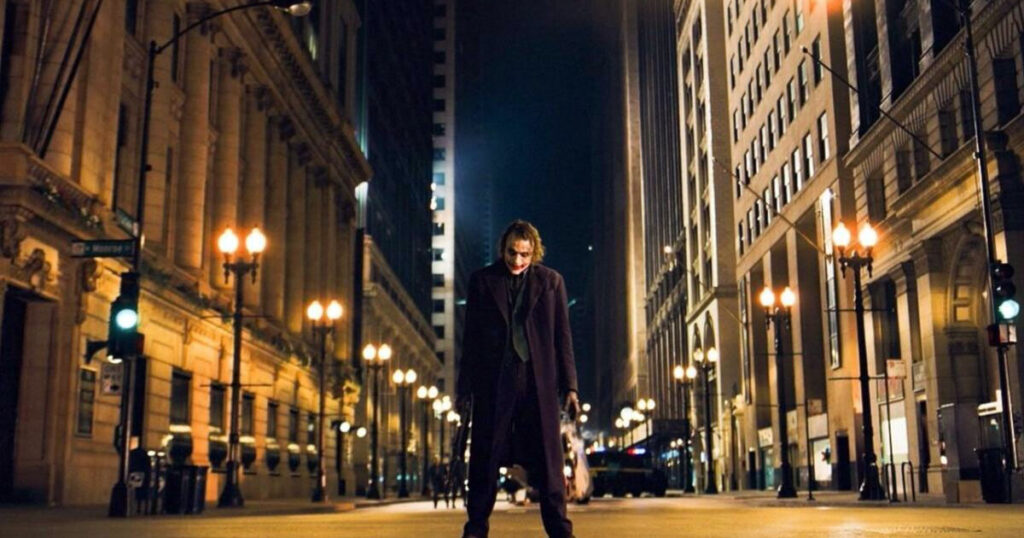
Before The Dark Knight shattered the mold, superhero films largely existed within a sanitized, brightly lit bubble of distinct good and evil. Richard Donner’s Superman gave us wholesome Americana; Tim Burton’s Batman provided gothic theatricality; and Sam Raimi’s Spider-Man offered earnest, colorful comic-book melodrama. Nolan, fresh off the critical success of Batman Begins (which grounded the origin story in ninja training and psychological fear), chose to strip away the remaining neon absurdity of the genre’s past. Instead, he presented Gotham City as Chicago—cold, metallic, brutal, sprawling, and undeniably real.
The film operates functionally as a high-stakes, Michael Mann-esque crime thriller, heavily and openly indebted to cinematic touchstones like Heat (1995) and The French Connection (1971). By establishing a world ruled not by supervillains with freeze rays, but by the mob, corrupt union officials, dirty cops, and international money laundering, Nolan creates a baseline of absolute, recognizable realism.
When the freakish elements—Batman and the Joker—are dropped into this hyper-realistic ecosystem, their impact is visceral and terrifying. We believe in the stakes because we recognize the world. The violence has a sickening weight to it. The politics have immediate consequences. The collateral damage is not faceless CGI buildings collapsing into dust, but deeply personal tragedies: a blown-up hospital, an assassinated judge, a poisoned police commissioner. By treating the source material with the gravitas of a historical war drama, Nolan demanded that the audience take the cape and cowl seriously.
The Joker: The Unstoppable Force and the Philosophy of Nihilistic Anarchism
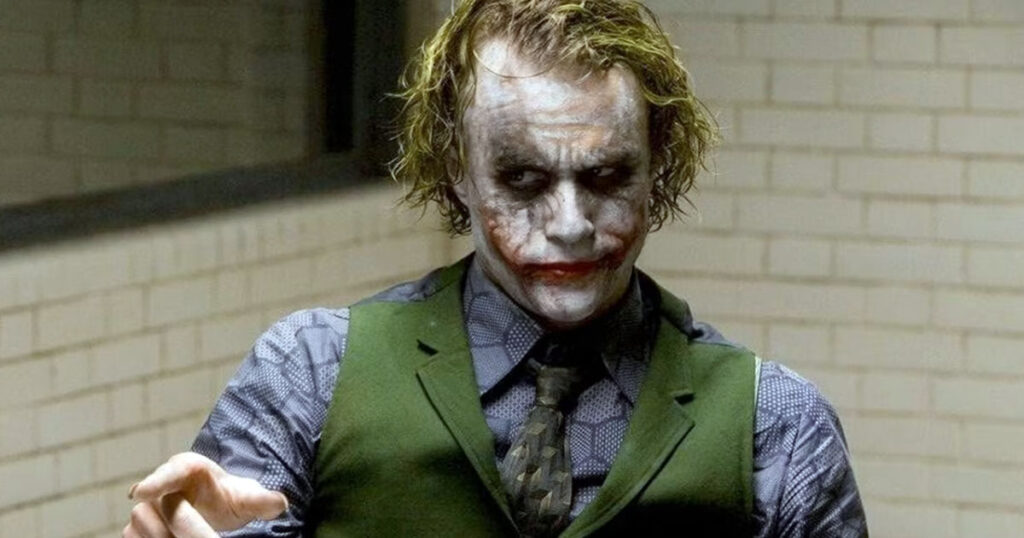
Any profound exploration of this film must inevitably anchor itself on Heath Ledger’s towering, immortal portrayal of the Joker. Ledger did not merely play a comic book villain; he embodied a terrifying, living philosophical concept. The Joker in The Dark Knight is utterly alien because he is not driven by the standard antagonistic motivations of wealth, global domination, political power, or personal revenge. As Alfred Pennyworth (Michael Caine) astutely and chillingly observes in an attempt to explain the unexplainable to Bruce Wayne: “Some men aren’t looking for anything logical, like money. They can’t be bought, bullied, reasoned, or negotiated with. Some men just want to watch the world burn.”
The Joker represents pure, unfiltered anarchy and aggressive nihilism. He is an agent of chaos whose sole objective is to prove a deeply cynical thesis: that human morality is a fragile, hypocritical construct, an “ugly joke” that humanity drops at the first sign of genuine trouble. What makes him arguably the greatest cinematic villain of the 21st century is that his terrifying nature stems not from physical strength, martial arts prowess, or magical powers, but from his supreme psychological dominance and unpredictability.
He has no definitive origin story. His changing narrative regarding his facial mutilation (“Do you want to know how I got these scars?”) is weaponized to manipulate whoever happens to be standing in front of him. To the mobster Gambol, it’s a story of an abusive father, preying on themes of domestic violence. To Rachel Dawes, it’s a story of a tragic wife, preying on her empathy. He is a ghost, an absolute unknown without fingerprints or dental records, making him entirely immune to the systemic logic of law enforcement.
The Interrogation Scene: A Masterclass in Character Dynamics
The legendary interrogation scene perfectly encapsulates the dynamic between the hero and the villain. It begins with the lights flipping on, revealing the Joker sitting in the dark, completely unfazed. Batman relies on intimidation, theatricality, and brutal physical force—tools that have worked flawlessly against mobsters and street thugs. Yet, these tools are completely useless against a man who welcomes physical pain and has absolutely nothing to lose.
“You have nothing, nothing to threaten me with. Nothing to do with all your strength,” the Joker laughs, entirely neutralizing the Batman’s greatest weapon. He absorbs Batman’s punches with gleeful laughter. The Joker is the unstoppable force meeting Batman’s immovable object, and their conflict is strictly ideological rather than physical. The Joker exposes Batman’s one rule (not to kill) as a weakness, while the Joker’s lack of rules is his greatest strength. He forces Batman into a lose-lose situation by making him choose between saving Rachel Dawes (the woman he loves) and Harvey Dent (the man Gotham needs).
The Tragedy of Harvey Dent: The True Narrative Arc and the Fall of the White Knight
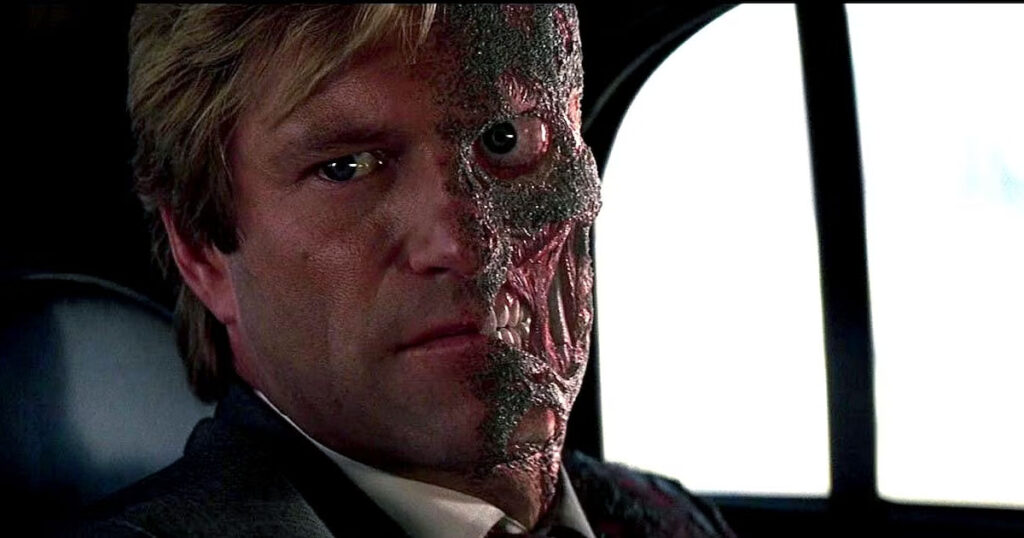
While the explosive Batman vs. Joker dynamic dominates the marketing and pop culture memory, the structural, emotional, and thematic spine of The Dark Knight belongs entirely to Aaron Eckhart’s Harvey Dent. From a screenwriting perspective, Dent is the actual tragic hero of the piece, the traditional protagonist whose hubris and subsequent fall from grace forms the emotional core of the narrative.
Gotham needed a hero with a face. Batman was the necessary evil of the night, a vigilante operating outside the law. But District Attorney Harvey Dent—dubbed the “White Knight” by the media—was the legitimate, legal, unmasked savior the city desperately craved. His arc is a devastating exploration of the fragility of righteousness. The Joker realizes early on that killing Batman would only turn him into a martyr. But corrupting Harvey Dent? That would destroy Gotham’s spirit permanently. The Joker doesn’t just want to kill Dent; he wants to break his soul, to prove his overarching thesis that even the best, most incorruptible of us can be reduced to a monster by a single “bad day.”
Nolan brilliantly foreshadows Dent’s internal darkness. Long before the explosion, we see Dent’s latent anger when he interrogates Thomas Schiff, one of the Joker’s schizophrenic thugs, threatening him with a revolver in a dark alley. The capacity for extreme violence was always there, held in check only by his belief in the system and the love of Rachel Dawes.
When Dent loses Rachel and half of his physical face in the warehouse explosion, his psychological break is entirely earned and horrifyingly inevitable. The brilliance of Dent’s transformation into Two-Face lies in its twisted, deeply traumatized logic. In a world where the rules of law and order failed him, where the “good” system allowed his innocent fiancée to burn alive, Dent abandons morality for absolute, terrifying fairness: chaos. “The only morality in a cruel world is chance,” he declares. “Unbiased, unprejudiced, fair.”
The flip of his scarred coin becomes his new judge, jury, and executioner. His tragic end forces the narrative into its most agonizing corner, requiring Batman to make the ultimate, self-destructive sacrifice to preserve the fragile illusion of hope that Dent once represented.
The Burden of Symbolism: Batman as the Scapegoat and the Post-9/11 Allegory
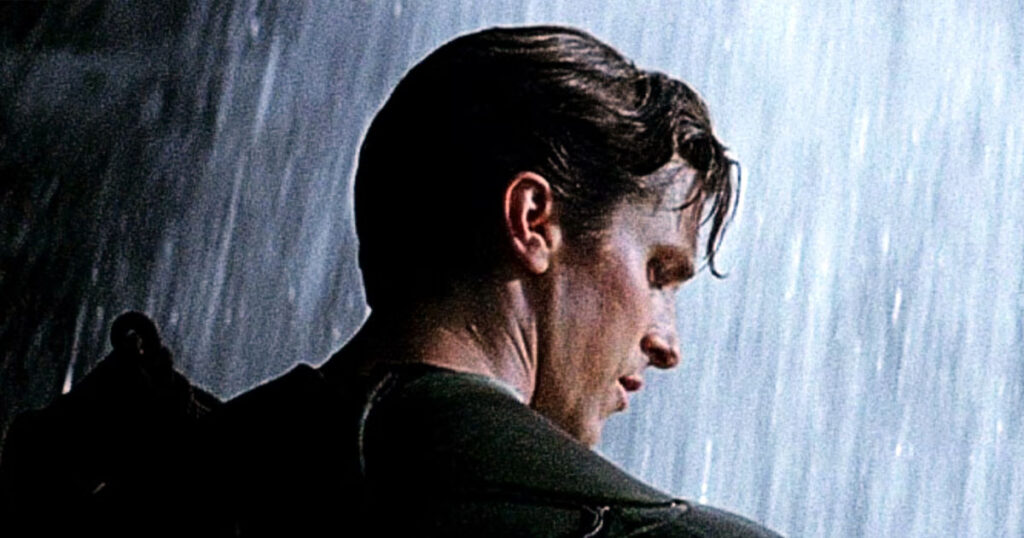
Christian Bale’s portrayal of Bruce Wayne and Batman in this middle chapter is often unfairly overshadowed by Ledger’s towering performance, yet it is utterly foundational to the film’s thematic resonance. Here, Bruce Wayne is forced to confront the harsh limitations of his own crusade. He realizes that his intimidating presence has acted as a catalyst, an escalation that birthed the very freaks he now battles. As Gordon warns him at the end of Batman Begins regarding escalation: “We start carrying semi-automatics, they buy automatics. We start wearing Kevlar, they buy armor piercing rounds.” The Joker is the direct, terrifying response to the Batman.
The film poses a series of harsh utilitarian questions: What is the true price of peace? How much civil liberty must be sacrificed for security? The Dark Knight serves as a profound allegory for the post-9/11 world and the War on Terror. Batman is constantly forced into impossible ethical dilemmas that mirror the anxieties of the 2000s.
This allegory reaches its zenith when Bruce Wayne utilizes Lucius Fox’s (Morgan Freeman) technology to turn every cell phone in Gotham into a sonar microphone, essentially violating the privacy of millions of citizens to find one terrorist. It is a direct parallel to the Patriot Act and warrantless wiretapping. Lucius Fox acts as the moral compass here, threatening to resign over this massive invasion of privacy. “This is too much power for one person,” Fox warns. Batman agrees, implementing a self-destruct sequence once the Joker is caught, demonstrating his ultimate restraint. He uses the unethical tool but refuses to let it become the new normal.
Ultimately, Batman accepts the role of the ultimate scapegoat. The film’s brilliant, devastating conclusion—where Batman willingly takes the blame for Harvey Dent’s murderous rampage to protect Dent’s pristine legacy—completely subverts the traditional superhero triumph. He doesn’t win a glorious victory; he merely survives by compromising his own image for the greater good. “He’s the hero Gotham deserves, but not the one it needs right now,” Gordon tearfully explains to his son as Batman is hunted by the police dogs.
Batman becomes the true Dark Knight, absorbing the sins of the city so its people can retain their faith in a false idol. It is an ending of staggering thematic weight, an act of supreme self-sacrifice that is far removed from the victorious, freeze-frame, sunset endings of the superhero films that preceded it.
The Supporting Pillars: Gordon, Alfred, and Lucius
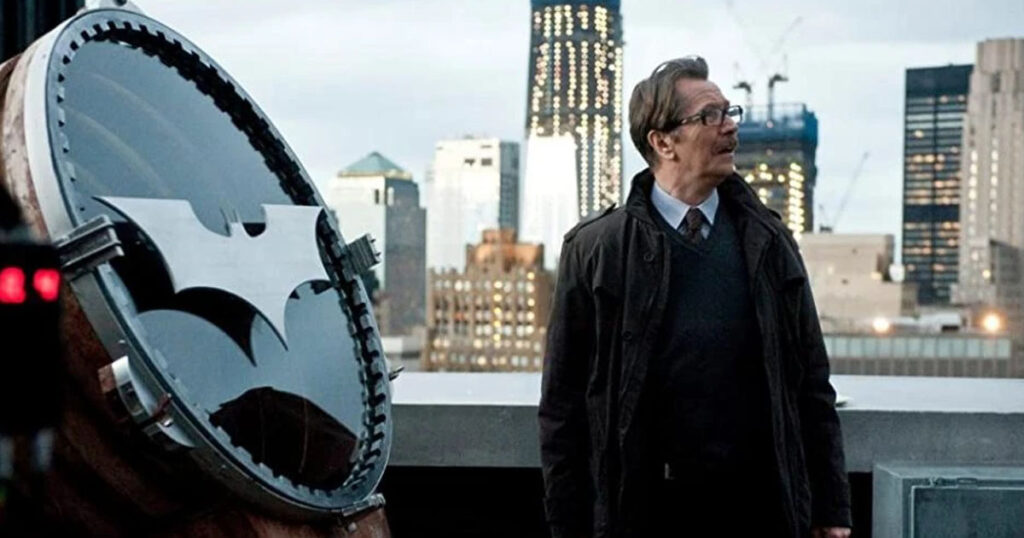
The thematic depth of The Dark Knight is further enriched by its flawless supporting cast, each representing a different facet of Gotham’s soul. Gary Oldman as Lieutenant (and later Commissioner) Jim Gordon represents the pragmatic, often compromised everyman. Gordon is a good cop in a bad town, forced to work with corrupt officers because he has no other choice. His decision to fake his own death to protect his family highlights the extreme, desperate measures required to survive in the Joker’s chaotic paradigm.
Michael Caine’s Alfred Pennyworth remains the emotional anchor and surrogate father to Bruce Wayne. However, even Alfred is forced into moral compromise. He understands the nature of the Joker better than Bruce initially does (the famous “ruby in the forest” monologue), and he ultimately makes the heartbreaking decision to burn Rachel’s final letter to Bruce. Alfred chooses a compassionate lie over a devastating truth, foreshadowing the film’s climactic decision to lie to Gotham about Harvey Dent.
Morgan Freeman’s Lucius Fox represents the ethical boundaries of technology and power. As the CEO of Wayne Enterprises and Batman’s quartermaster, Fox is the one man who can say “no” to Bruce Wayne. His ultimate refusal to manage the sonar machine underscores the film’s central thesis about the corrupting nature of absolute power.
The Cinematic Craft: Tension, Pacing, Cinematography, and Score
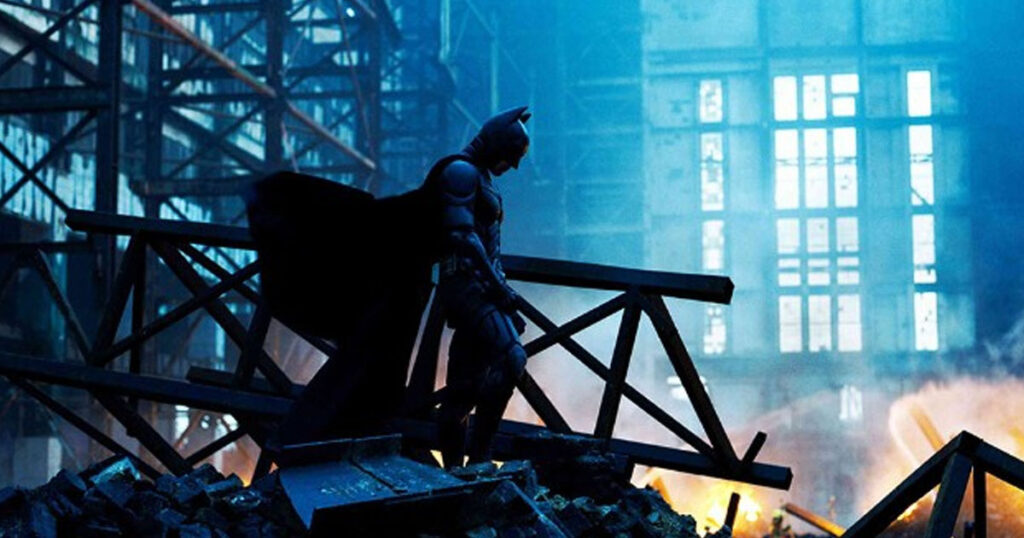
Beyond the brilliant script crafted by Jonathan and Christopher Nolan, the sheer technical execution of The Dark Knight is a masterclass in filmmaking. Wally Pfister’s cinematography, notably utilizing bulky IMAX 70mm cameras for key action sequences (a rarity for feature films at the time), gives the film a sweeping, epic grandeur while maintaining a gritty, street-level, documentary-like texture. The opening bank heist, shot entirely in IMAX, immediately plunges the audience into an immersive, vertigo-inducing experience.
Nolan’s commitment to practical effects over CGI gives the film a timeless quality. When the Joker flips an 18-wheeler truck end-over-end in the middle of downtown Chicago, it is a real truck flipping on a real street. When the hospital explodes, it is a real building being demolished. This tangible reality grounds the narrative, making the danger feel ever-present and authentic.
However, the unsung hero of the film’s relentless, suffocating momentum is the score by Hans Zimmer and James Newton Howard. They purposefully avoided a traditional, heroic brass theme for Batman, opting instead for driving, pulsing strings that resemble a ticking clock or the flapping of bat wings.
For the Joker, Zimmer created a revolutionary, deeply uncomfortable soundscape. The Joker’s theme, titled “Why So Serious?”, is essentially built around a single, escalating, agonizing note on an electric cello that stretches out like a taut wire ready to snap. It sounds like a razor blade on a piano string. It doesn’t tell you how to feel; it wraps around your nervous system and tightens, creating a sense of perpetual, sickening unease. Combined with Lee Smith’s razor-sharp editing, the film maintains the pace of a ticking time bomb for two and a half hours, never allowing the audience—or the characters—a moment to breathe or feel safe.
The Masterful Dilemma: The Ferry Experiment and the Core of Human Nature
Perhaps the most philosophically engaging sequence in the entire superhero canon is the grand social experiment on the Gotham ferries during the film’s climax. The Joker rigs two boats with massive amounts of explosives—one filled with innocent, terrified civilians, the other with hardened, convicted criminals. He gives each boat the detonator to the other vessel and issues an ultimatum: blow up the other boat by midnight, or he will blow up both.
It is a classic game theory scenario, a prisoner’s dilemma escalated to a horrific, mass-casualty extreme. The Joker is betting his entire philosophy on this moment. He is convinced that the “civilized” people will shed their morality to save their own lives, proving his point that everyone is as ugly and selfish as he is deep down.
In almost any other modern, cynical, grimdark film, one boat would inevitably blow the other up to showcase the depravity of man. Yet, in his darkest film, Nolan offers a rare, profound, and deeply moving glimmer of hope. Neither the civilians (who vote to blow the criminals up but cannot bring themselves to turn the key) nor the hardened criminals (where a towering, intimidating prisoner takes the detonator from the warden and throws it out the window) can cross that ultimate moral line.
The Joker’s grand thesis fails. He is left bewildered as midnight passes and neither boat explodes. This moment is absolutely crucial to the thematic integrity of the film because it justifies Batman’s entire crusade. It proves that the people of Gotham are inherently good, or at least capable of choosing good, even in the face of imminent, terrifying death. It is a powerful, optimistic counterweight to the bleakness of Harvey Dent’s tragic corruption.
A Legacy Unmatched and the Evolution of Cinema
As time passes, the media consensus surrounding Christopher Nolan’s achievement only solidifies, yet the film continues to invite fresh, personalized interpretations with every viewing. Critics often hail it as the “Godfather Part II of comic book movies,” a sequel that deepened, darkened, and fundamentally expanded the mythology of its predecessor.
Its impact on the film industry was immediate and permanent. The outcry over The Dark Knight failing to secure a Best Picture nomination at the Academy Awards was so deafening that the Academy literally changed its rules the following year, expanding the Best Picture category from five to up to ten nominees to ensure that critically acclaimed blockbusters would not be ignored again. It cast a massive, intimidating shadow over both the DC Extended Universe (which spent years trying to replicate its grim tone without understanding its thematic depth) and the Marvel Cinematic Universe (which opted to go in the exact opposite direction of bright, interconnected, serialized comedy-action).
However, when we synthesize the broad critical acclaim with a deeper look at the cultural zeitgeist, The Dark Knight is more than just an influential Hollywood trendsetter. It is a profound cinematic essay on the morality of the modern world.
It bravely eschews the comforting, black-and-white morality of its genre to live entirely in the murky, uncomfortable gray areas. It asks brutal questions about how far a society should go to protect itself, the destructive nature of unchecked chaos, the fragility of the justice system, and the agonizing, often unseen weight of true sacrifice. We return to The Dark Knight time and time again—not just for the visceral thrill of the Batpod flipping through traffic, the spectacle of a hospital crumbling to the ground, or the hypnotic magnetism of Heath Ledger’s Joker—but because it holds a dark, unflinching mirror up to our own society.
It remains the best superhero movie of all time precisely because it vehemently refuses to be categorized merely as one. Instead, it stands tall as a timeless, harrowing, and intellectually stimulating masterpiece of modern cinema that will be studied and revered for generations to come.