The Joker. The Clown Prince of Crime. The Harlequin of Hate. Few characters in pop culture have transcended their comic book origins to become such enduring, malleable symbols. When examining the legacy of every Joker actor, it becomes clear that he is the yin to Batman’s yang, the chaotic force that necessitates the Dark Knight’s rigid order. But the beauty—and the terror—of the Joker lies in his adaptability. Every generation, every medium, gets the Joker it needs. He is a blank canvas painted with the anxieties, neuroses, and theatricality of the era in which he is performed.
This isn’t just a list of actors in makeup; it’s an exploration of an evolving archetype. From the campy capers of the swinging sixties to the gritty realism of the modern era, the Joker has morphed from a harmless prankster into a terrifying reflection of societal decay. He is an agent of chaos, a tragic victim, a flamboyant gangster, and a terrifying cipher.
In this comprehensive analysis, we will dissect every Joker actor, examining the unique flavor each brought to the role, the psychological underpinnings of their interpretations, and the lasting impact they’ve had on the legacy of Batman’s greatest foe. Prepare to delve into the madness.
Cesar Romero: The Technicolor Trickster (1966-1968)
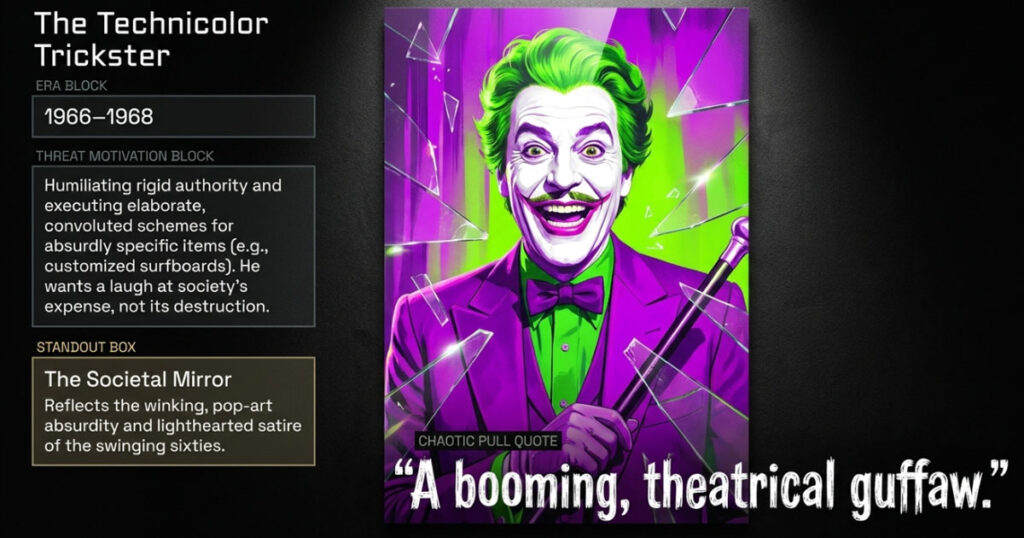
Cesar Romero’s Joker is often dismissed by modern audiences as too campy, a relic of a bygone era. But to understand Romero’s impact, one must understand the context. The 1966 Batman television series was a pop-art explosion, a deliberate, winking satire of comic books that leaned heavily into the absurd. Romero didn’t play a psychopathic killer; he played a gleeful, mischievous prankster, perfectly suited for the show’s lighthearted tone.
The Aesthetics of Camp
Romero’s visual presentation was iconic, even if it lacked the edge of later iterations. The vibrant purple suit, the stark white face paint (famously applied over his signature mustache, which he refused to shave), and the shock of green hair were a literal translation of the Silver Age comic book aesthetic. He was loud, physically expressive, and constantly in motion. His laugh wasn’t a chilling cackle; it was a booming, theatrical guffaw, a sound of genuine, manic amusement.
The Harmless Anarchist
Unlike the modern Jokers who seek to tear down society, Romero’s Joker just wanted to have a laugh at society’s expense. His crimes were elaborate, convoluted schemes designed to humiliate Batman and Robin or steal absurdly specific items (like a customized surfboard). He wasn’t a murderer; he was a nuisance, a brightly colored thorn in the side of Gotham’s rigid authority.
Romero’s performance laid the foundation for the character’s theatricality. He established the Joker as a character who doesn’t just commit crimes; he performs them. He views the world as a stage, and he is the star attraction. While he may lack the psychological depth of his successors, Romero’s pure, unadulterated glee in the role remains a vital piece of the Joker’s history. He is the baseline from which all future deviations are measured.
Jack Nicholson: The Homicidal Artist (1989)

Tim Burton’s 1989 Batman changed the landscape of superhero cinema, and Jack Nicholson’s Joker was the catalyst. Nicholson brought A-list gravity to the role, transforming the character from a TV prankster into a genuinely terrifying, yet undeniably charismatic, mobster. This Joker wasn’t just crazy; he was an artist whose medium was murder.
The Genesis of the “Smile”
Nicholson’s origin story—falling into a vat of acid after a confrontation with Batman—solidified the physical deformity aspect of the character. The permanent rictus grin, created by groundbreaking prosthetics, gave him an unsettling permanence. Even when he was delivering a mundane line, he looked completely unhinged. Nicholson leaned into his own innate charm and menace, creating a Joker who was as comfortable schmoozing at a museum gala as he was electrocuting a mob boss.
“I’m the World’s First Fully Functioning Homicidal Artist”
This line perfectly encapsulates Nicholson’s interpretation. His Joker saw himself as a visionary, bringing “joy” to a dull world through colorful, deadly chaos. He vandalized priceless art, defaced statues, and used toxic gas disguised as parade balloons. His crimes were spectacles, designed to be both horrifying and strangely captivating.
Nicholson brought a level of sadism to the role that hadn’t been seen before. He reveled in the pain he inflicted, yet he delivered it with a smirk and a snappy one-liner. He was the mobster turned monster, a perfect foil for Michael Keaton’s brooding, repressed Batman. Nicholson proved that a comic book villain could be genuinely frightening, setting the stage for the darker interpretations that would follow.
Mark Hamill: The Definitive Voice (1992-Present)
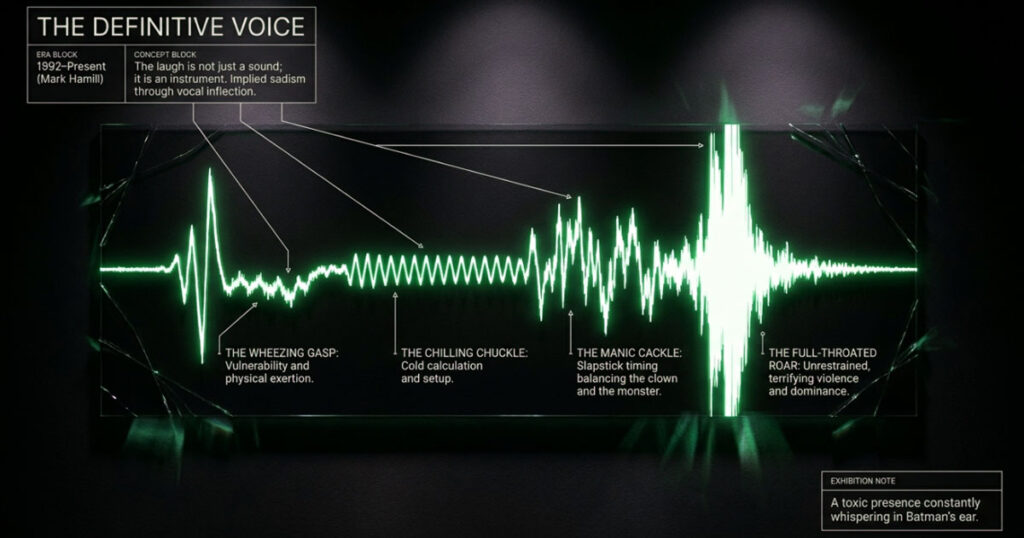
While he may not have portrayed the character in live-action, Mark Hamill is widely considered by many fans to be the definitive Joker. His voice work, beginning with Batman: The Animated Series and continuing through numerous animated films and the Arkham video game series, has shaped the character’s auditory identity for over three decades.
The Anatomy of a Laugh
Hamill’s genius lies in his understanding that the Joker’s laugh is not just a sound; it’s an instrument. He developed a vast repertoire of laughs: the chilling chuckle, the manic cackle, the wheezing gasp, the full-throated roar. Each laugh serves a different purpose, reflecting the Joker’s mood, his level of sadism, and his relationship with Batman.
Balancing the Clown and the Monster
What makes Hamill’s Joker so compelling is his ability to balance the character’s inherently contradictory elements. He can be genuinely funny, delivering puns and slapstick with impeccable timing, but he can turn terrifyingly violent on a dime. The Animated Series was aimed at children, so Hamill had to imply the character’s sadism without showing explicit gore. He achieved this through vocal inflection, a chilling edge that suggested he was always one bad joke away from snapping someone’s neck.
In the Arkham games, freed from the constraints of children’s television, Hamill unleashed the full, terrifying potential of his Joker. He became a toxic presence, a voice constantly whispering in Batman’s ear, a testament to the symbiotic relationship between the two characters. Hamill proved that you don’t need a physical presence to dominate the screen; sometimes, the voice in the dark is the most terrifying thing of all.
Heath Ledger: The Agent of Chaos (2008)
Heath Ledger’s performance in Christopher Nolan‘s The Dark Knight is the high-water mark for comic book villainy. It is a masterclass in acting, a performance so raw, so unsettling, and so undeniably brilliant that it redefined the character for a new generation and earned Ledger a posthumous Academy Award.
A World Without Rules
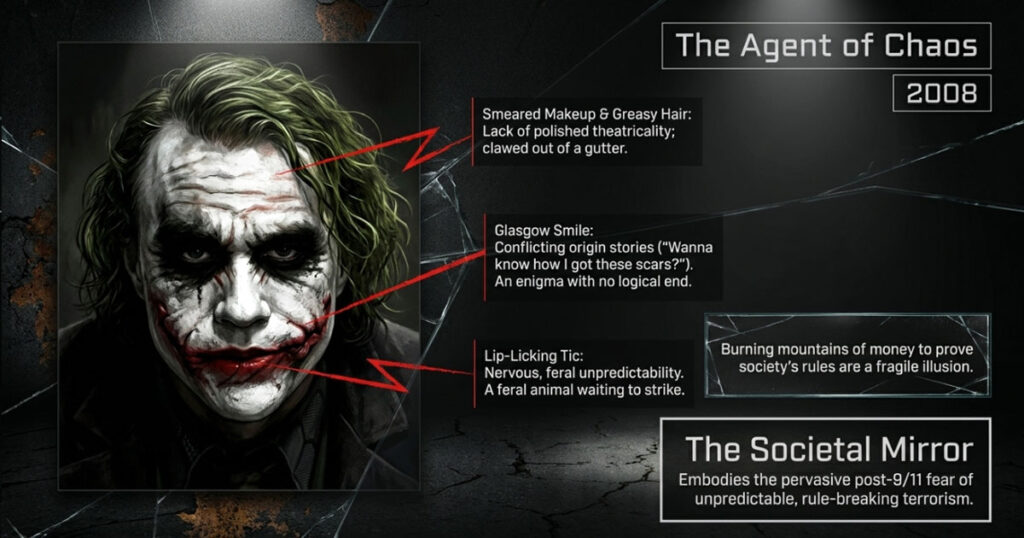
Ledger’s Joker wasn’t a gangster, a failed comedian, or an artist. He was, in his own words, “an agent of chaos.” He existed solely to prove that society’s rules were a fragile illusion. He didn’t want money (he literally burned a mountain of it); he wanted to tear down the established order and expose the hypocrisy of the “civilized” world.
The Aesthetics of Anarchy
Ledger’s physical transformation was crucial to the role. The scarred, Glasgow smile, the hastily applied, smeared makeup, the greasy hair—this Joker looked like he had clawed his way out of a gutter. He lacked the polished theatricality of Nicholson; his movements were erratic, twitchy, like a feral animal waiting to strike. He constantly licked his lips, a nervous tic that added to his unsettling presence.
Ledger’s vocal performance was equally unnerving. He fluctuated between a menacing whisper and a sudden, sharp bark. His multiple, conflicting origin stories (“Wanna know how I got these scars?”) perfectly illustrated his nature: he was an enigma, a force of nature with no clear beginning and no logical end. He was the ultimate test for Christian Bale’s Batman, pushing him to the absolute brink of his moral code. Ledger didn’t just play the Joker; he inhabited the madness.
Jared Leto: The Cartel Kingpin (2016)
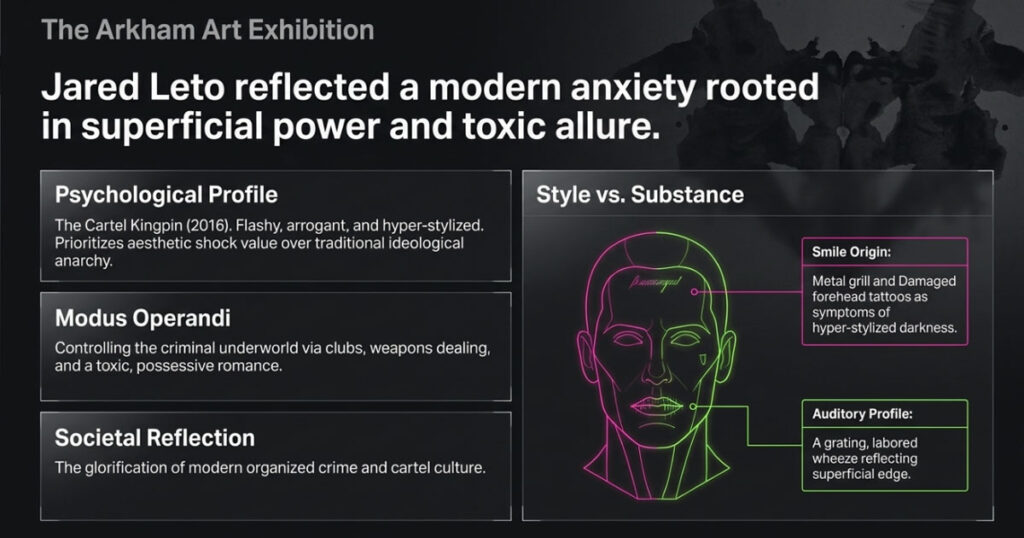
Jared Leto’s interpretation in Suicide Squad is undoubtedly the most polarizing on this list. It’s a drastic departure from the character’s roots, leaning heavily into a modern, hyper-stylized aesthetic that divided audiences and critics.
The Modern Gangster
Leto’s Joker wasn’t an anarchist or a traditional mobster; he was a modern cartel kingpin. He was draped in expensive clothes, covered in tattoos (including a controversial “Damaged” tattoo on his forehead), and possessed a grating, grill-covered smile. He was flashy, arrogant, and deeply entrenched in the criminal underworld, running clubs and dealing weapons.
Style Over Substance?
The criticism often leveled at Leto’s portrayal is that it prioritized aesthetic shock value over psychological depth. His relationship with Harley Quinn was central to his storyline, but it often felt more like a toxic, possessive romance than the manipulative dynamic seen in other media. His laugh, a slow, labored wheeze, lacked the iconic ring of his predecessors.
However, it’s important to acknowledge that Leto’s screentime in Suicide Squad was severely truncated, making it difficult to fully assess his performance. While his interpretation may not resonate with traditional fans, it reflects a specific, modern anxiety: the glorification of organized crime and the toxic allure of power and wealth. Leto’s Joker is a reflection of a different kind of darkness—one that is flashy, aggressive, and entirely superficial.
Cameron Monaghan: The Proto-Jokers (2014-2019)
Cameron Monaghan’s performance in the television series Gotham is unique because he didn’t play “The Joker” in a traditional sense. Due to complex rights issues, he played Jerome and Jeremiah Valeska, twin brothers who served as the ideological precursors to the Clown Prince of Crime. This allowed Monaghan to explore different facets of the character’s mythology over several seasons.
Jerome: The Anarchic Spark
Jerome Valeska was the raw, unrefined chaos. Raised in a circus, he was a sociopath with a theatrical flair and a chilling, cackling laugh that clearly channeled Mark Hamill. Jerome represented the infectious nature of the Joker’s madness, a cult leader who inspired followers to embrace anarchy. Monaghan brought a terrifying energy to the role, portraying Jerome as a rabid dog unleashed upon the city.
Jeremiah: The Cold Calculator
When Jerome died, his twin brother Jeremiah was exposed to a specialized laughing gas, transforming him into a different kind of monster. Jeremiah was the cold, calculating mastermind. He was highly intelligent, meticulous, and obsessed with Bruce Wayne. He represented the intellectual threat of the Joker, the architect of elaborate, devastating schemes.
The Synthesis of Madness
In the final season, the character (now simply referred to as “J”) is a horrific amalgamation of the two brothers, bearing physical scars and a terrifyingly calm demeanor. Monaghan’s journey through these different iterations is a remarkable achievement. He essentially built the Joker from the ground up, exploring the character’s psychological components—the anarchy, the intellect, the obsession—before synthesizing them into a terrifying final form.
Joaquin Phoenix: The Tragic Victim (2019)
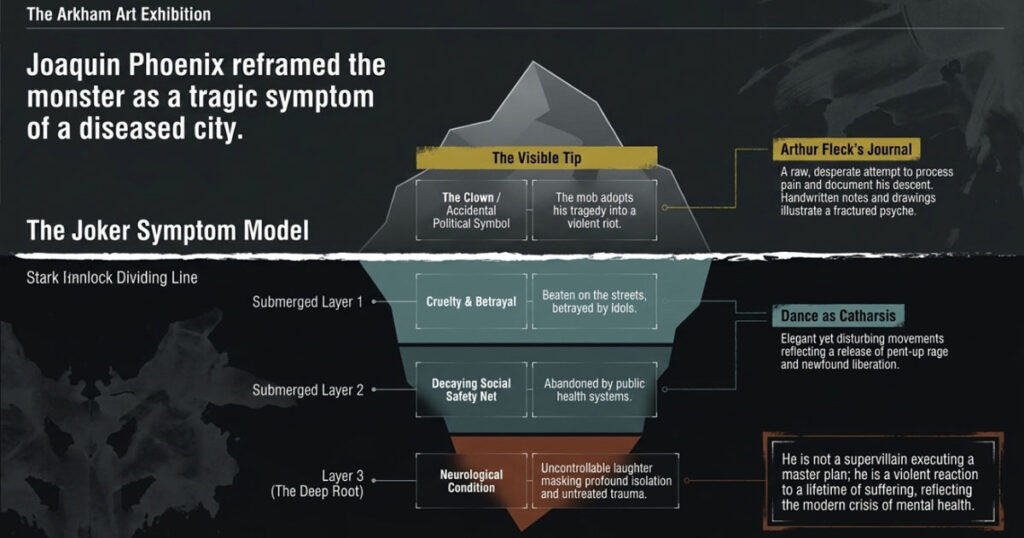
Todd Phillips’ Joker took the character out of the comic book universe entirely, presenting a grim, Scorsese-inspired character study of a man spiraling into madness. Joaquin Phoenix’s Arthur Fleck is the most grounded, human interpretation of the character to date, earning him an Academy Award for Best Actor.
The Pathology of Arthur Fleck
Phoenix didn’t play a mastermind or a supervillain; he played a deeply disturbed, profoundly lonely man failed by a decaying society. Arthur Fleck suffers from a neurological condition that causes him to laugh uncontrollably at inappropriate times, a tragic irony for a man who desperately wants to be a stand-up comedian. Phoenix’s physical transformation—his emaciated frame and contorted movements—viscerally conveyed Arthur’s pain and isolation.
The Making of a Monster
The brilliance of Phoenix’s performance lies in his ability to elicit empathy for a character who commits horrific acts. We see Arthur pushed to the brink by a cruel world—beaten on the streets, betrayed by his idol, and abandoned by the social safety net. His descent into the Joker isn’t a master plan; it’s a tragic, violent reaction to a lifetime of suffering.
The film’s controversial climax, where Arthur incites a city-wide riot, frames him not as a leader, but as an accidental symbol. The mob adopts his clown persona, turning his personal tragedy into a violent political movement. Phoenix’s Joker is a terrifying reflection of societal neglect, a reminder that monsters are often created by the very societies that fear them. He is the Joker not as a mastermind, but as a symptom of a diseased city.
Barry Keoghan: The Grotesque Enigma (2022)
Matt Reeves’ The Batman offered only a fleeting glimpse of the next iteration of the Joker, played by Barry Keoghan. Although his screen time was minimal, restricted mostly to a shadowed cameo at the end of the film (and a longer deleted scene released later), Keoghan’s portrayal immediately established a distinct, terrifying tone.
The Unseen Horror
Reeves described this version of the character not as “the Joker” yet, but as a “proto-Joker,” an unnamed inmate in Arkham Asylum who already shares a history with Batman. The focus of Keoghan’s performance is heavily heavily reliant on atmosphere and implication.
The Aesthetics of Decay
The visual design is perhaps the most grotesque interpretation yet. It’s not makeup or a chemical bath; it’s a congenital condition that forces his face into a permanent, painful-looking smile. The scarring is horrific, suggesting a lifetime of self-mutilation or disease. The deleted scene reveals a character who is already deeply embedded in Batman’s psyche, acting as a twisted, Hannibal Lecter-esque profiler.
Keoghan’s voice work is equally unsettling—a wet, rattling laugh that sounds less like amusement and more like a symptom of physical decay. This Joker isn’t flashy or theatrical; he is a festering wound in the heart of Arkham. He represents a profound, deeply disturbing psychological threat, a character who understands the darkness within Batman better than anyone else. While we have only seen fragments, Keoghan promises a Joker who is a truly terrifying, elemental force of nature.
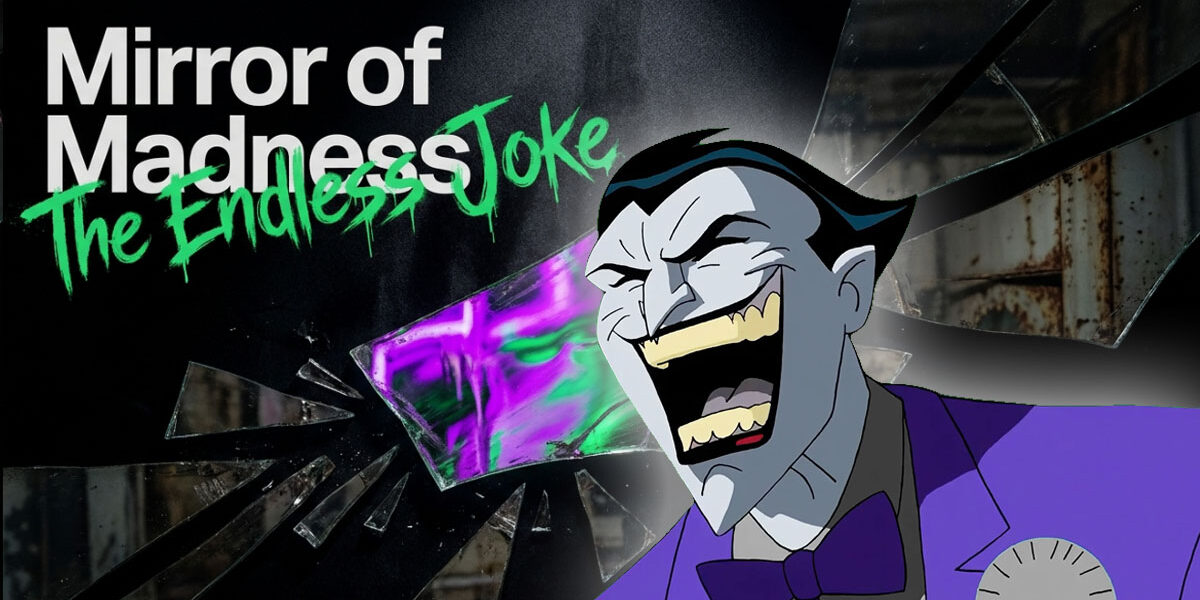
The Endless Joke
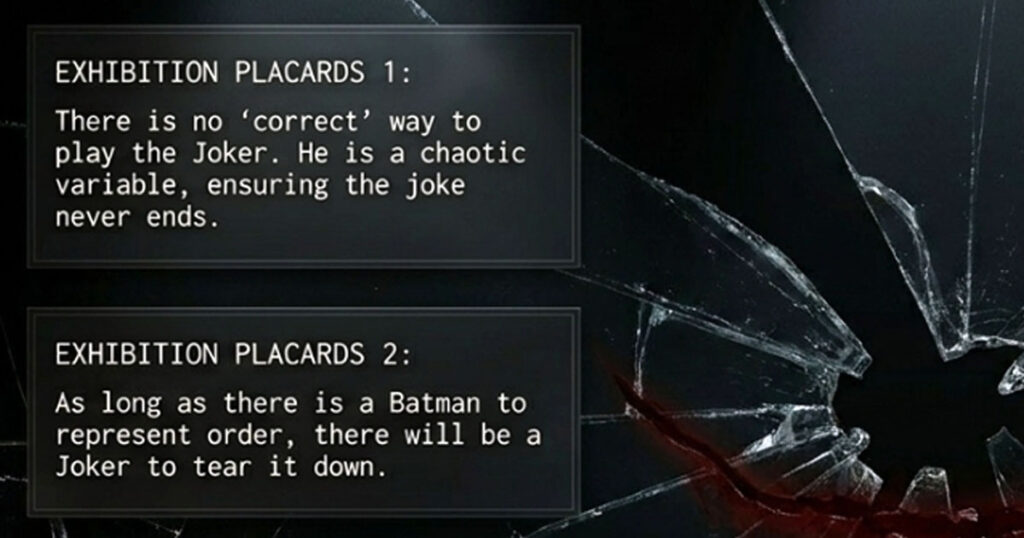
The Joker is not a single character; he is a mirror. Every actor who dons the makeup reflects back the fears, anxieties, and stylistic preferences of their specific cultural moment. Cesar Romero gave us the pop-art prankster of the 60s. Jack Nicholson brought the dangerous glamor of the 80s mobster. Heath Ledger embodied the post-9/11 fear of unpredictable terrorism. Joaquin Phoenix highlighted the modern crisis of mental health and societal decay.
There is no “correct” way to play the Joker, and that is precisely why the character continues to fascinate us. He is a chaotic variable, a blank slate upon which actors and directors can project their darkest visions. As long as there is a Batman to represent order, there will be a Joker to tear it down, evolving and adapting, ensuring that the joke—however dark, however terrifying—never truly ends.