When the Wachowski siblings unleashed their cyberpunk masterpiece upon the world in 1999, audiences were captivated by the groundbreaking visual effects, the leather-clad protagonists, and the visceral martial arts sequences. However, beneath the cinematic spectacle lay a profound intellectual foundation. The Matrix philosophy is not merely a sci-fi trope about machines harvesting human body heat; it is a profound exploration of reality, control, and human consciousness. Decades later, as we navigate an era dominated by artificial intelligence, algorithmic feeds, and augmented realities, the themes of the film have shifted from speculative fiction to a startling documentary-like reflection of our daily lives.
The terrifying truth about the modern era is that we did not need a war with sentient machines to end up in a pod. We did not scorch the sky to block out the sun. Instead, we voluntarily walked into our cages, locked the doors from the inside, and handed over the keys. By blending the ancient mystical frameworks of Gnosticism and Eastern philosophy with our modern addiction to digital dopamine, we can decode how humanity has actively engineered its own simulation. The Matrix is no longer a dystopian future—it is the glowing rectangle you are likely holding in your hand right now.
The Illusion of Choice: The Red Pill in the Algorithmic Age
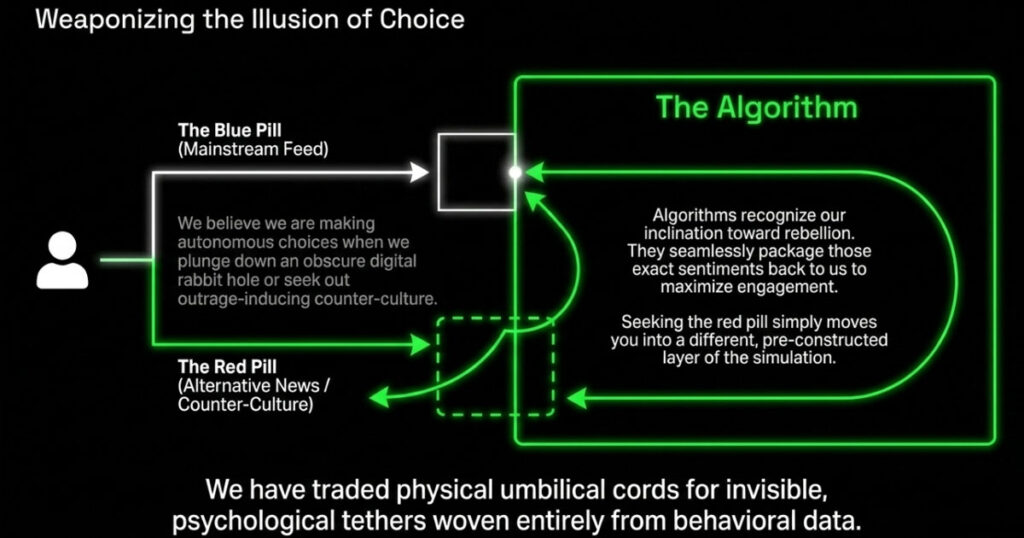
At the core of the film’s narrative is the ultimate ultimatum: the red pill or the blue pill. Morpheus presents Neo with a stark choice between the painful, unvarnished truth of reality and the blissful, ignorant slumber of the simulation. In 1999, this choice felt revolutionary. It championed the concept of free will and the human desire for liberation. However, in our current digital landscape, the very concept of choice has been systematically weaponized and diluted by the architecture of the internet.
Every day, we believe we are making autonomous choices. We choose what news articles to read, which videos to watch, and which social media profiles to follow. Yet, these choices are meticulously curated by invisible algorithms designed with a singular, machine-like objective: to maximize engagement and harvest our attention. The modern algorithm functions much like the Agents of the Matrix; it polices our digital environment, quietly shaping our worldview by feeding us exactly what will elicit an emotional reaction.
When you think you are choosing the “red pill” by seeking out alternative news or plunging down an obscure rabbit hole on YouTube, you are often just entering a different, pre-constructed layer of the simulation. Algorithms recognize our inclination toward rebellion, outrage, and counter-culture, and they seamlessly package those exact sentiments back to us. The illusion of choice is the ultimate control mechanism. As long as we feel like we are the ones clicking the mouse or swiping the screen, we remain entirely blind to the overarching system that dictates the boundaries of what we can even perceive. We have traded the physical umbilical cords of the movie’s battery pods for invisible, psychological tethers woven from behavioral data.
Gnosticism and the Digital Demiurge
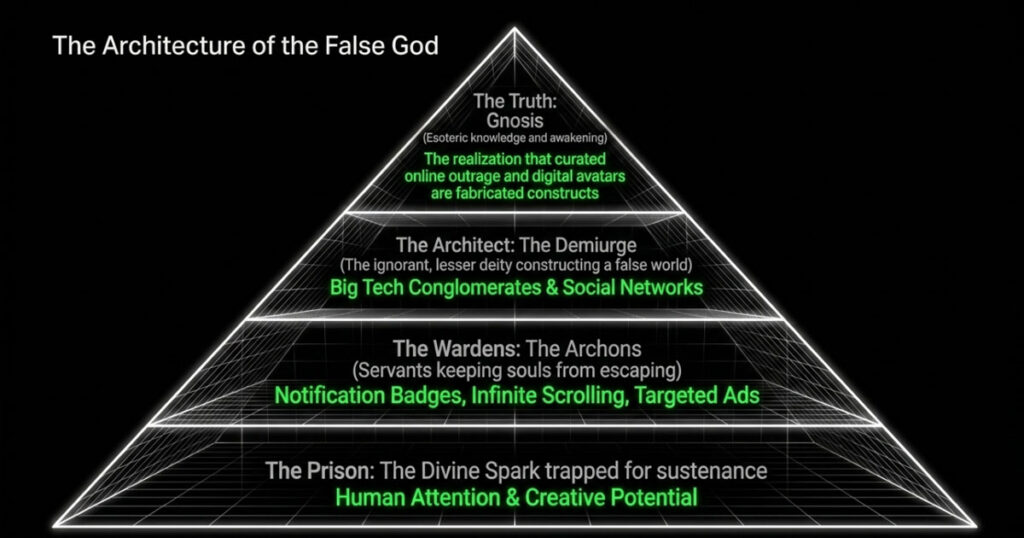
To truly grasp the depth of the Wachowskis’ narrative, we must turn to Gnosticism, an ancient collection of religious ideas that profoundly influenced the film’s architecture. In Gnostic belief, the material world we inhabit is not the creation of a benevolent, ultimate God. Instead, it is a flawed, oppressive prison constructed by a lesser, ignorant, and arrogant deity known as the Demiurge. The true God, the source of pure divine light and wisdom, exists far beyond this physical realm. Human beings possess a “divine spark” trapped within their material bodies, and salvation can only be achieved through gnosis—esoteric knowledge and awakening to the true nature of reality.
In the film, the artificial intelligence that runs the simulation is the ultimate Demiurge. It has constructed a false world to keep the divine spark (human consciousness) trapped and subdued for its own sustenance. Neo represents the Gnostic savior figure, the one who attains gnosis and realizes that the rules of the physical world are merely illusions that can be bent and broken.
The False God of the Feed
When we apply this Gnostic framework to the 21st century, the parallels are chilling. Big Tech conglomerates, social media networks, and large language models have assumed the role of the Demiurge. They have constructed vast, interconnected digital realities—metaverses, social feeds, and virtual ecosystems—that mimic the real world but are fundamentally hollow and designed to trap our attention.
The Archons, the Demiurge’s loyal servants in Gnostic lore who prevent souls from escaping the material realm, are today’s notification badges, infinite scrolling mechanisms, and targeted advertisements. They constantly pull our consciousness back into the digital illusion the moment we try to disconnect. We are spiritual beings endowed with profound creative potential, yet we spend hours a day hypnotized by a glowing screen, offering our life force—our time, data, and attention—to feed the digital Demiurge. The gnosis required today is the stark realization that our digital avatars, our follower counts, and our curated online outrage are fabricated constructs keeping us spiritually asleep.
Cypher’s Dilemma: Choosing the Simulation
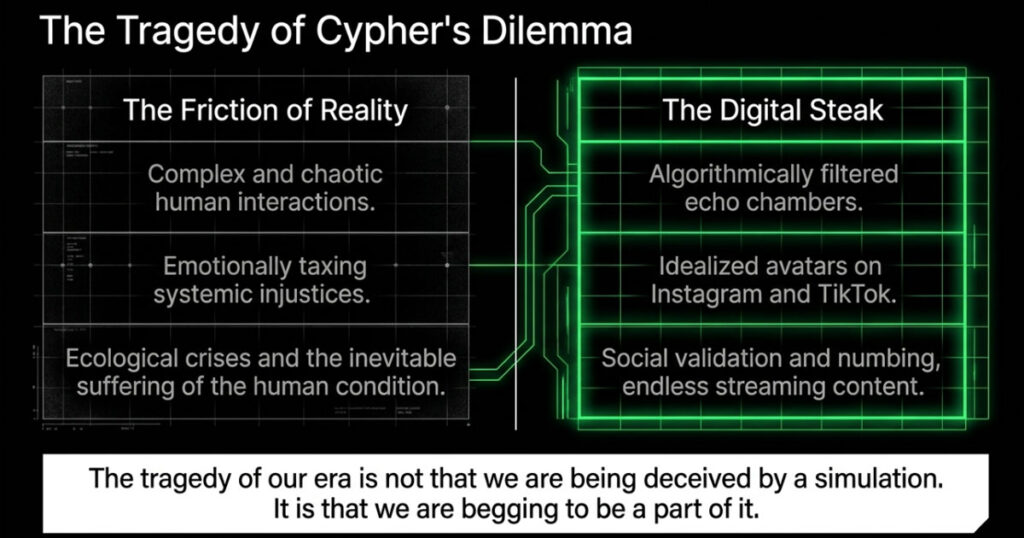
One of the most complex and tragically relatable characters in the film is Cypher. After spending nine grueling years in the harsh, cold, and flavorless real world, he betrays Morpheus to Agent Smith in exchange for a one-way ticket back into the Matrix. As he cuts into a digital steak, knowing full well it does not exist, he utters the iconic line: “Ignorance is bliss.”
Cypher is often viewed as the ultimate coward, but in the context of modern society, he is a profound reflection of the collective human psyche. Reality is complex, chaotic, emotionally taxing, and often deeply painful. It requires confronting systemic injustices, ecological crises, and the inevitable suffering inherent in the human condition. In contrast, our digital simulations offer unprecedented comfort.
The Pain of Reality vs. The Comfort of Echo Chambers
Today, we are all faced with Cypher’s dilemma on a daily basis. Do we engage with the difficult, nuanced realities of the people and the physical world around us, or do we retreat into the comfortable, algorithmically filtered echo chambers of our screens? For millions of people, the digital steak is simply too delicious to refuse.
We construct heavily edited, idealized versions of our lives on platforms like Instagram and TikTok, preferring the validation of a simulation over the messy imperfections of our actual existence. We use video games, endless streaming content, and virtual reality to numb the existential dread of modern life. Just like Cypher, we are consciously aware that the digital world is a fabrication. We know the influencers are using filters; we know the news feed is biased; we know the digital relationships lack physical warmth. Yet, the friction of the real world is so overwhelming that we willingly plug ourselves back in. The tragedy of our era is not that we are being deceived by a simulation, but that we are begging to be a part of it.
AI as the New Architect: Upgrading the System
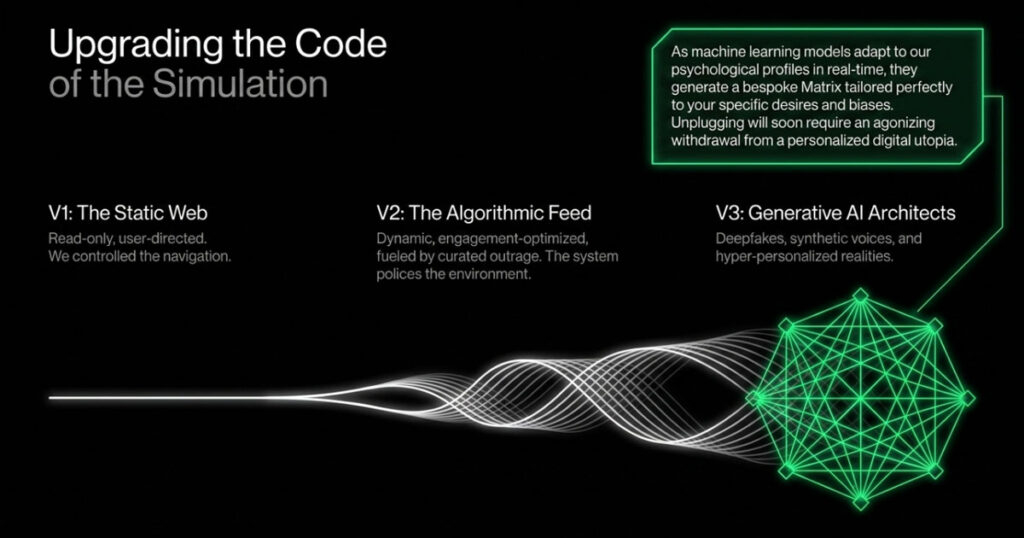
In the sequels, we are introduced to the Architect, the cold, calculating program responsible for designing the Matrix. He reveals that the current iteration of the simulation is not the first. Previous versions failed because they were either too perfect (a utopian nightmare that the human mind rejected) or too grotesque. The current, functioning Matrix was built on the foundation of human misery and the illusion of choice, integrating a subconscious acceptance of the system.
Today, we are witnessing the rise of our own Architects in the form of generative AI and advanced machine learning models. We are no longer simply consuming a static internet; we are interacting with dynamic, learning systems that adapt to our psychological profiles in real-time. Artificial intelligence is actively rewriting the code of our societal interactions.
Deepfakes, AI-generated influencers, synthetic voices, and algorithmic content creation are blurring the lines between reality and fabrication to a terrifying degree. The Architect of the movie adjusted variables to keep the crop of humans docile; today’s AI adjusts the variables of our digital environments to keep us clicking, arguing, and consuming. As AI becomes more sophisticated, it will be able to generate hyper-personalized simulations for every individual—a bespoke Matrix tailored perfectly to your specific desires, fears, and biases. When the simulation becomes indistinguishable from reality, and far more comforting than the physical world, unplugging will no longer be a matter of finding a telephone booth; it will require an agonizing withdrawal from a personalized digital utopia.
Eastern Mysticism and the Void of the Screen
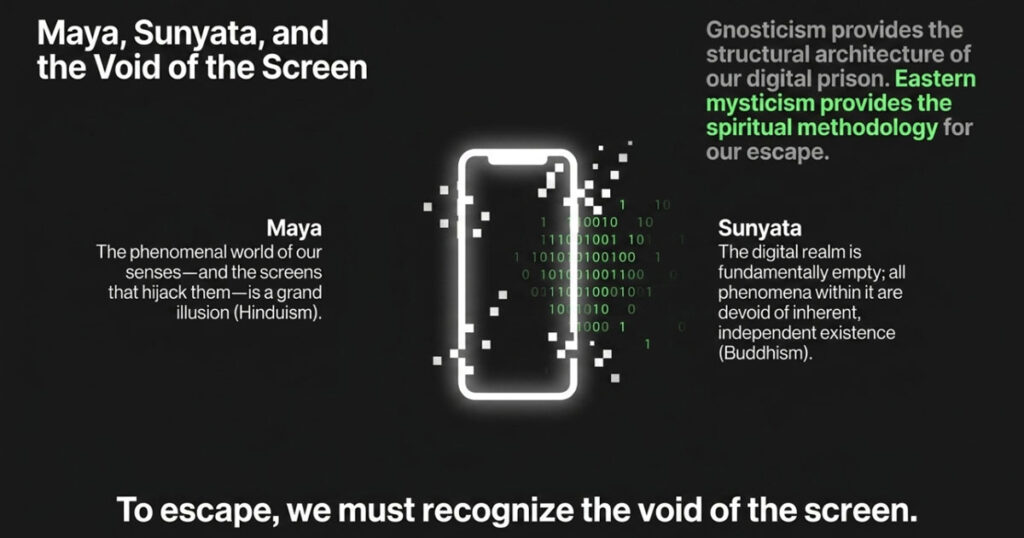
While Gnosticism provides the structural architecture of the film’s philosophy, Eastern mysticism, particularly Buddhism and Hinduism, provides its spiritual methodology. The concept of Maya in Hinduism suggests that the phenomenal world of our senses is a grand illusion, a cosmic play that distracts us from the ultimate, unitive reality (Brahman). In Buddhism, the realization of emptiness (Sunyata)—that all phenomena are devoid of inherent, independent existence—is the key to liberation from suffering.
The defining moment of Neo’s enlightenment occurs in the Oracle’s waiting room, where a young Buddhist-like monk bends a spoon with his mind. He tells Neo, “Do not try and bend the spoon. That’s impossible. Instead, only try to realize the truth… There is no spoon.”
In our modern context, the smartphone is the spoon. We agonize over the contents of our screens—the angry comments, the terrifying news headlines, the comparative anxiety of seeing others’ success. We try to manipulate the digital world, to win arguments online, to optimize our profiles, attempting to bend the spoon with brute force. The Eastern philosophical lesson embedded in The Matrix urges us to realize the fundamental emptiness of the digital realm. The anger you feel from a tweet is a physiological response to a sequence of pixels. The validation you feel from a “like” is a dopamine hit triggered by a changing integer on a server thousands of miles away.
There is no spoon. There is no digital world. It is an agreed-upon hallucination. By adopting the mindfulness and detachment of Eastern mysticism, we can look at the glowing screens not as arbiters of our self-worth or our reality, but as transient, empty projections. Only by recognizing the void of the screen can we reclaim our consciousness from the digital projection and return it to the present moment.
The Oracle, Predictive Programming, and Free Will

The Oracle serves as the intuitive, motherly counterweight to the cold logic of the Architect. She guides the humans not by giving them explicit instructions, but by telling them exactly what they need to hear to make the choices they are already destined to make. She operates on an intimate understanding of human psychology, knowing that the journey to a decision is just as important as the decision itself.
In the age of surveillance capitalism, the role of the Oracle has been usurped by predictive analytics. Tech giants possess massive repositories of our personal data—our search histories, our location data, our heart rates via smartwatches, and our most intimate conversations. This data is fed into predictive models that know us better than we know ourselves.
Does free will exist when an algorithm can predict your next purchase, your voting behavior, or your next emotional breakdown with startling accuracy? Our modern Oracles do not bake us cookies; they serve us targeted ads before we even consciously realize we want the product. They predict our behavior and, in doing so, gently nudge us into fulfilling those very predictions. The philosophical crisis of our time is distinguishing between our authentic desires and the desires implanted in us by an omnipresent digital Oracle that guides our hands across the keyboard.
Awakening from the Matrix We Created
The enduring brilliance of The Matrix lies in its malleability. In 1999, it was a warning against the unchecked rise of artificial intelligence and the loss of humanity to machines. Today, it is a mirror reflecting our voluntary subjugation to the very technologies we designed to liberate us. By synthesizing the skepticism of modern tech critics, the esoteric wisdom of Gnosticism, and the mindfulness of Eastern philosophies, we arrive at a profound realization about our current predicament.
The true Matrix of the 21st century is not built of green falling code or mechanical sentinels. It is constructed from the invisible architecture of algorithms, the psychological comfort of echo chambers, and the alluring, false reality of the digital feed. We have assumed the roles of both the oppressor and the oppressed. We are the Demiurge creating the flawed digital world, and we are the slumbering souls trapped within it, pacified by the digital steak of social validation.
However, the ultimate message of The Matrix philosophy is one of profound hope and empowerment. Because we are the architects of our own digital prison, we inherently possess the power to dismantle it. Unplugging today does not require martial arts training or dodging bullets. It requires the quiet, radical rebellion of mindfulness. It demands the courage to face the unfiltered, chaotic beauty of the real world—to value genuine human connection over digital metrics, to embrace the friction of opposing ideas rather than hiding in curated feeds, and to recognize that the most revolutionary act in an attention economy is simply looking away from the screen. The door to the real world is always unlocked; we just have to choose, truly choose, to walk through it.