When we talk about great, transformative performances in the history of cinema, the conversation inevitably and inescapably drifts toward “The Method.” It’s a term whispered with profound reverence by some, and occasionally met with rolled eyes or heavy sighs by others in Hollywood circles. Method Acting has become a buzzword, often misused by entertainment media to describe any actor who gains weight, loses weight, or refuses to answer to their real name on a movie set. But what exactly is Method Acting? Is it simply the stubborn refusal to break character between takes, a gimmick used for Oscar campaigns, or is it a profound, sometimes perilous psychological descent into another human being’s soul?
In this comprehensive exploration, we will dissect the fascinating, occasionally disturbing, and always captivating world of Method Acting. We will travel back in time to explore its true, somewhat misunderstood roots in Russian theatre, trace its evolution across the Atlantic to the gritty stages of New York, examine the iconic actors who champion it, and finally, dive into the ongoing, unresolved debate about its necessity, its artistry, and its safety in modern filmmaking.
The Era of Artificiality: Acting Before The Method
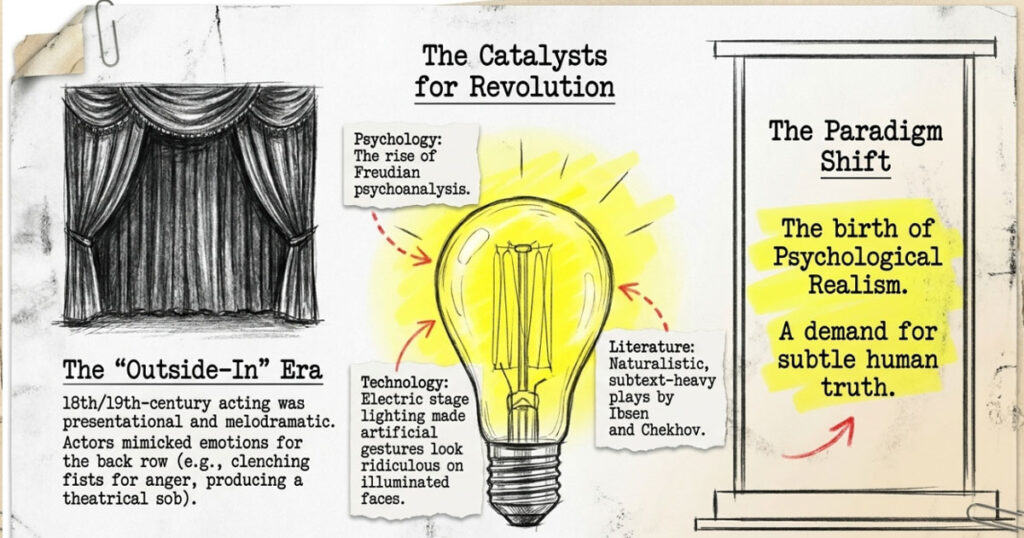
To truly appreciate the seismic shift that Method Acting brought to performance art, we must first understand what acting looked like before it existed. Throughout the 18th and 19th centuries, acting in the Western world was largely presentational, deeply rooted in melodrama and declamation.
Actors of this era did not strive for “psychological realism.” Instead, they relied on a codified system of external gestures, vocal inflections, and physical postures to convey emotion to the audience. If a character was angry, the actor might clench their fists, stomp their feet, and bellow their lines at the top of their lungs. If they were sorrowful, they would clutch their chest, cast their eyes downward, and perhaps produce a theatrical sob.
It was an outside-in approach. The audience came to see the performance of an emotion, not the experience of it. Actors played directly to the back row of the theatre, prioritizing audibility and grand sweeping movements over subtle human truth. The concept of an actor drawing from their own personal trauma to play a fictional role would have been considered utterly bizarre, if not entirely inappropriate.
However, as the world entered the late 19th century, the cultural zeitgeist began to shift. The rise of psychology (spearheaded by figures like Sigmund Freud), advancements in naturalistic literature, and the invention of electric stage lighting (which allowed audiences to see actors’ faces clearly) all demanded a new kind of storytelling. The grand, artificial gestures of melodrama suddenly looked ridiculous under bright lights and in the face of complex, psychologically driven texts by playwrights like Henrik Ibsen and Anton Chekhov. The stage was set for a revolution.
What Exactly is Method Acting?
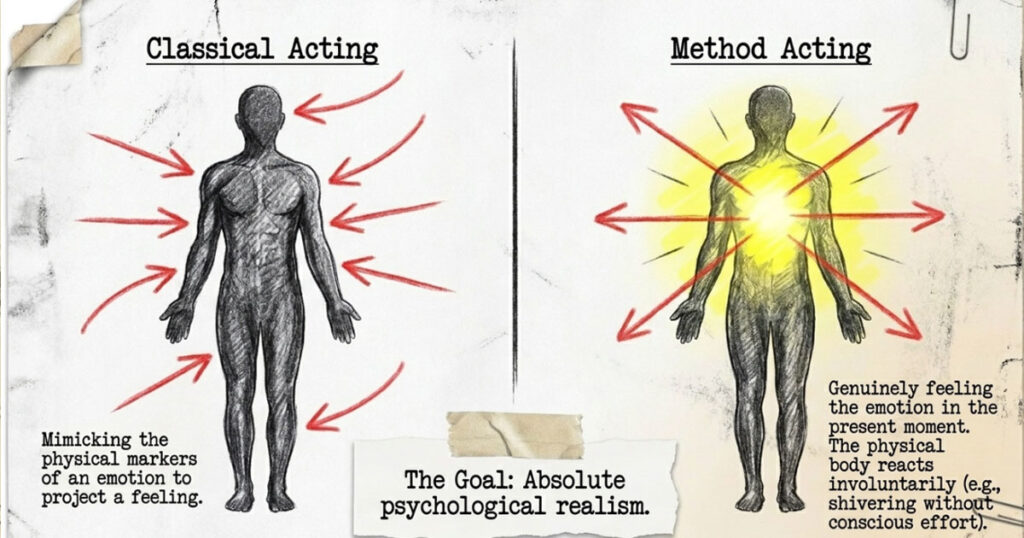
At its most fundamental core, Method Acting is an array of training and rehearsal techniques formulated to encourage sincere, emotionally expressive, and psychologically truthful performances. Unlike the classical, presentational acting of the past, which relied heavily on external expressions—mimicking the physical markers of an emotion—Method Acting requires the actor to genuinely feel the emotions of their character in the present moment.
The ultimate goal is absolute psychological realism. A Method actor is trained not to just pretend to be sad; they recall a profound personal tragedy or utilize their imagination to evoke genuine, unforced tears. They don’t just act like they are freezing in a blizzard; they might spend hours in a cold environment, or use deep sensory exercises to internalize the physical sensation of ice on their skin, so their body naturally shivers without conscious effort. It is a deeply internal, inside-out approach to the craft of acting.
While the specific techniques vary depending on which branch of “The Method” an actor studies, the key exercises often associated with Method Acting include:
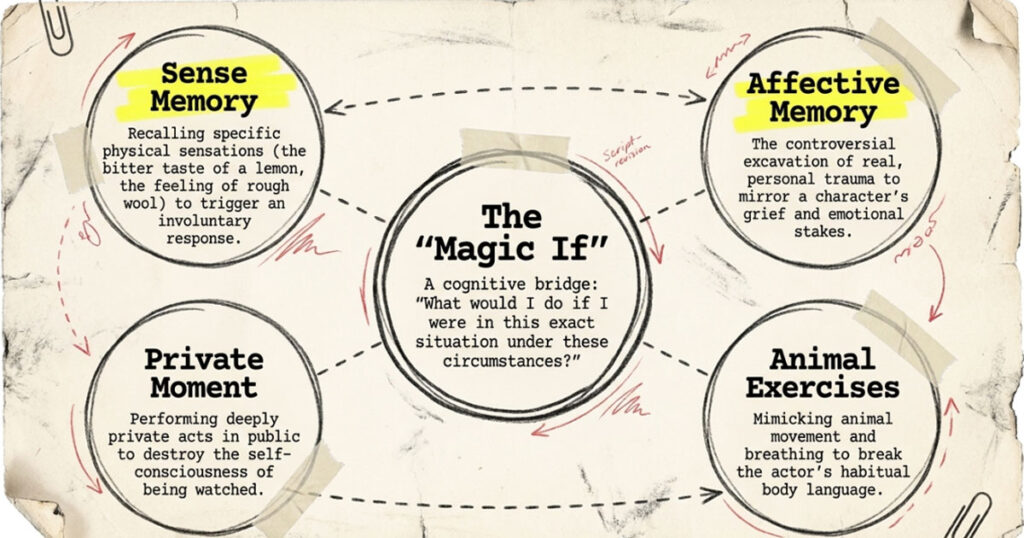
- Sense Memory: This is a foundational exercise. It involves recalling specific physical sensations (the bitter taste of a lemon, the smell of cheap coffee, the feeling of rough wool, the sharp pain of a papercut) to trigger a genuine, involuntary physical and emotional response in the present scene. The actor trains their body to remember and recreate reality.
- Affective Memory (Emotional Memory): This is often the most famous, and certainly the most controversial, aspect of the Method. It requires the actor to delve deep into their own personal history to find a real-life memory that mirrors the emotional stakes of the character’s situation. For instance, if a character is mourning a lost child, the actor might vividly recall the death of a beloved pet or a painful breakup to access a wellspring of genuine grief.
- The “Magic If”: A cognitive exercise that bridges the gap between the actor’s reality and the character’s fiction. The actor asks themselves, “What would I do if I were in this exact situation, with this character’s background, under these circumstances?” It forces the actor to personalize the text.
- Private Moment Exercise: Designed to help actors overcome the self-consciousness of being watched. An actor performs an activity they would normally only do in absolute privacy (like singing wildly in the shower, or examining a bodily flaw in the mirror) in front of an audience, learning to be genuinely private in public.
- Animal Exercises: Observing and intricately mimicking the movement, breathing, and behavior of specific animals to develop a character’s physicality and instinctual responses, moving away from the actor’s own habitual body language.
The Origins: From Russia with Raw Emotion
To trace the DNA of Method Acting, we must travel back to late 19th and early 20th century Russia. The foundational principles were laid not by a modern American acting coach in a Hollywood studio, but by a passionate Russian theatre practitioner named Konstantin Stanislavski.
Konstantin Stanislavski and the “System”
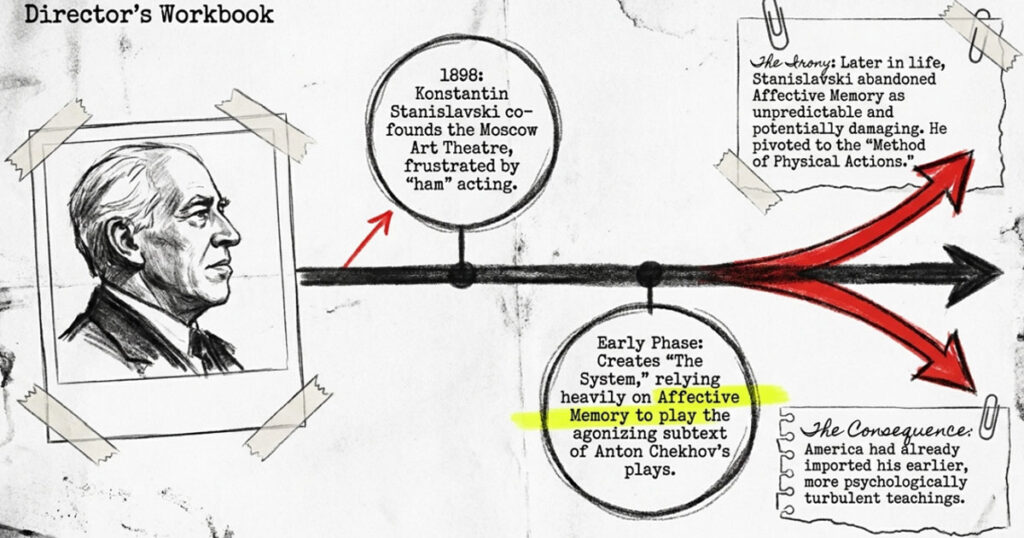
Konstantin Stanislavski, a wealthy amateur actor who went on to co-found the legendary Moscow Art Theatre in 1898, grew deeply frustrated with the melodramatic, stylized acting prevalent on the Russian stages of his youth. He described the acting of his peers as “ham,” feeling it lacked humanity, nuance, and truth.
Stanislavski sought a more naturalistic style of performance. He wanted the audience to forget they were watching a play and believe they were eavesdropping on real life. Through decades of relentless experimentation, observation, and trial-and-error, he developed his “System”—a comprehensive set of techniques designed to help actors access genuine emotion and construct a rich inner life for their characters.
Stanislavski’s System emphasized the “Magic If,” the identification of a character’s “Super-Objective” (what they want more than anything in life), and the breaking down of a script into actionable “beats.” Crucially, in his early and mid-career work, Stanislavski heavily promoted “Affective Memory,” believing that drawing on personal trauma and lived experience was the only reliable path to truthful acting.
It was during this period that Stanislavski directed the plays of Anton Chekhov, such as The Seagull and Uncle Vanya. Chekhov’s characters rarely said exactly what they meant; their dialogue was full of subtext, hidden desires, and unspoken grief. The old presentational style of acting was useless here. Stanislavski’s System provided the tools actors needed to play the agonizing subtext of Chekhov’s masterpieces, revolutionizing theatre forever.
(A vital historical footnote: It’s crucial to note that later in his life, Stanislavski actually moved away from Affective Memory. He found it to be unpredictable and, in some cases, potentially psychologically damaging to his actors. In his final years, he developed the “Method of Physical Actions,” arguing that physical movement and physiological actions could stimulate emotional truth more reliably and safely than digging up old traumas. However, the Americans who imported his teachings had already latched onto his earlier, more psychologically turbulent ideas.)
The Journey to America: The Birth of The Group Theatre
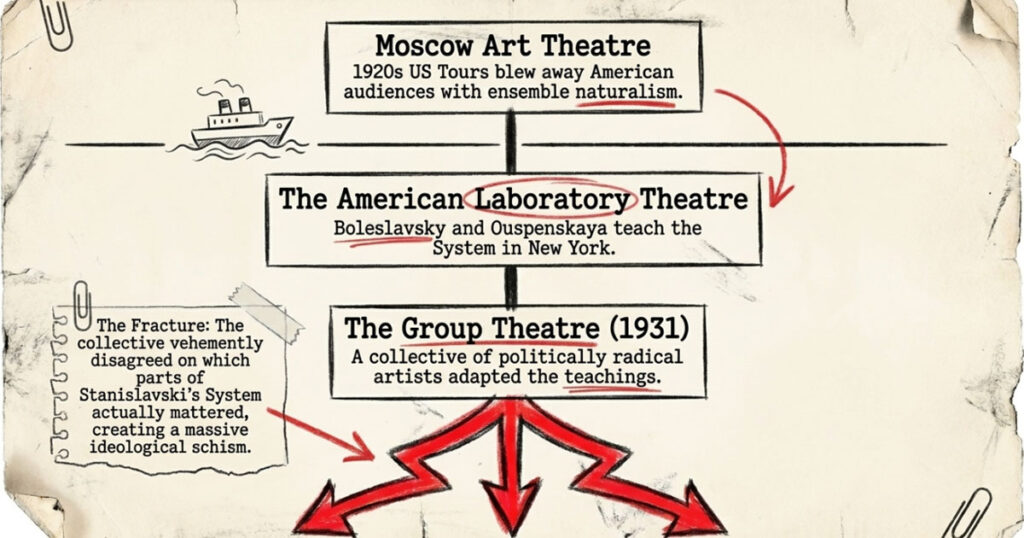
Stanislavski’s System did not stay confined to Russia. The Moscow Art Theatre conducted several highly successful tours of the United States in the early 1920s. American audiences and actors were utterly blown away by the ensemble work, the naturalistic dialogue, and the intense emotional reality of the Russian performers. It was unlike anything seen on Broadway before.
Two of Stanislavski’s former students, Richard Boleslavsky and Maria Ouspenskaya, remained in New York and founded the American Laboratory Theatre to teach the System. Their teachings deeply influenced a group of young, idealistic, and politically radical American theatre artists.
In 1931, these artists formed The Group Theatre, a collective aimed at producing socially relevant plays with a unified, truthful acting style. This legendary collective included names that would become the absolute titans of American acting pedagogy: Lee Strasberg, Stella Adler, and Sanford Meisner, along with brilliant directors like Elia Kazan.
These passionate teachers took Stanislavski’s teachings and adapted them for the American temperament. However, they soon began to vehemently disagree with each other on which parts of Stanislavski’s System were the most important, leading to a massive ideological schism that still divides acting schools today.
The Great Divide: Strasberg, Adler, and Meisner
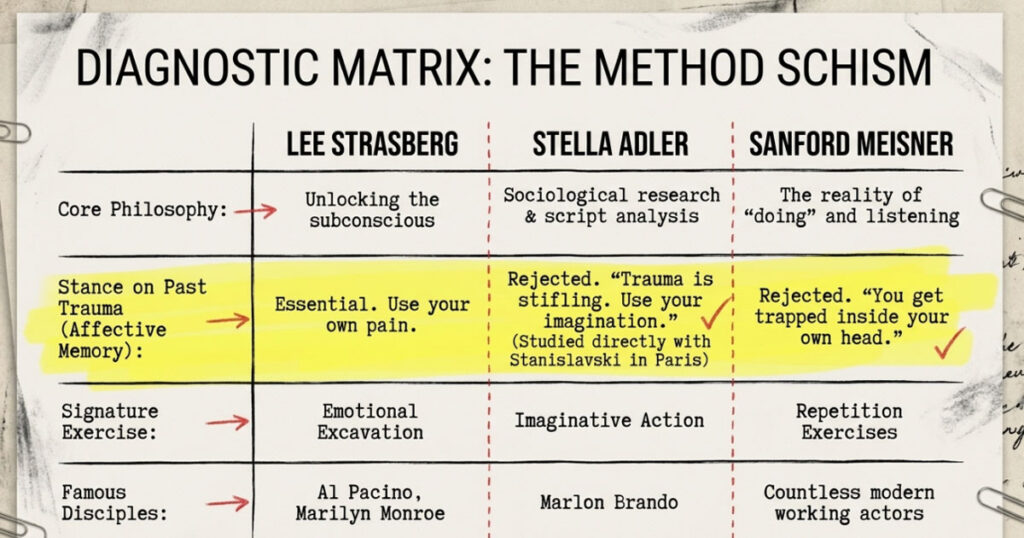
The term “Method Acting” as it is commonly understood today is most closely associated with the specific interpretation of Stanislavski’s work championed by Lee Strasberg.
Strasberg latched tightly onto Stanislavski’s early emphasis on Affective Memory. He believed that the absolute key to brilliant acting was unlocking the actor’s own subconscious, breaking down their psychological defenses, and excavating their emotional history. Strasberg demanded that his actors use their own pain to fuel their characters. He later became the artistic director of the famed Actors Studio in New York, a crucible where many of the 20th century’s greatest actors honed their craft under his intense, sometimes guru-like gaze.
However, Stella Adler, a prominent member of The Group Theatre, vehemently disagreed with Strasberg’s reliance on past trauma. Feeling creatively stifled, Adler actually traveled to Paris in 1934 and managed to secure five weeks of private study with Konstantin Stanislavski himself. She discovered that Stanislavski had largely abandoned Affective Memory in favor of imagination and physical action.
Adler returned to America and dramatically challenged Strasberg, stating, “He [Stanislavski] loved me, and he said you were wrong!” Adler went on to found her own studio, emphasizing sociological research, the power of a vibrant imagination, and script analysis over personal emotional excavation. Her most famous student would eventually be Marlon Brando.
Sanford Meisner, another Group Theatre alum, also found Strasberg’s approach too introverted and neurotic. Meisner believed that Strasberg’s actors became trapped inside their own heads. Meisner developed his own technique, focusing intensely on the reality of “doing” and listening in the moment between actors. His famous repetition exercises trained actors to stop thinking about themselves and focus entirely on their scene partner, reacting authentically to the behavior they were receiving in real-time.
Despite these intense disagreements, it was Strasberg’s psychologically rigorous, emotionally agonizing interpretation that the media dubbed “The Method,” and it was this version that took Hollywood by storm.
The Pioneers: Bringing The Method to the Silver Screen
The Method, born on the stage, found its most enduring legacy on celluloid. The transition was largely shepherded by Elia Kazan, a founding member of The Group Theatre who became a powerhouse film director. He cast Actors Studio alumni in his films, changing cinematic acting overnight.
Marlon Brando: The Earthquake
No conversation about Method Acting is complete without Marlon Brando. While Brando always credited Stella Adler as his primary teacher and famously disliked Lee Strasberg, his performances embodied the naturalistic, deeply internal style that defined the era.
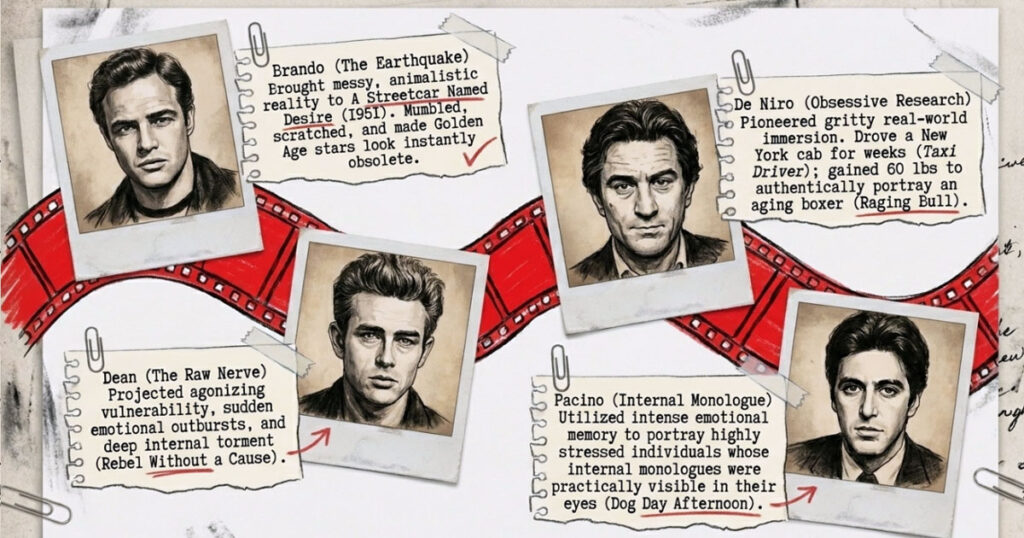
When Brando burst onto the screen in Kazan’s A Streetcar Named Desire (1951), playing the brutish Stanley Kowalski, he altered the trajectory of acting forever. He mumbled, he scratched himself, he was unpredictable, animalistic, and raw. He didn’t sound like a trained actor reciting lines; he sounded like a real, deeply flawed human being caught on camera. Brando brought a messy, visceral reality to cinema that made the polished stars of the Golden Age look instantly obsolete.
James Dean: The Raw Nerve
James Dean, another disciple of the Actors Studio, brought a different flavor of The Method to the screen. In films like Rebel Without a Cause (1955) and East of Eden (1955), Dean projected an agonizing vulnerability and teenage angst that felt unprecedentedly authentic.
Dean was known for his intense concentration and his ability to access deep wells of personal sorrow. His performances were characterized by sudden outbursts of emotion, physical awkwardness, and a palpable sense of internal torment. His tragic, premature death only cemented his status as the patron saint of tortured Method actors.
The Gritty 70s: De Niro and Pacino
The Method found a perfect home in the gritty, morally ambiguous cinema of the 1970s. Actors like Robert De Niro and Al Pacino, both steeped in Method techniques, delivered iconic performances that pushed the boundaries of physical and psychological preparation.
Robert De Niro became legendary for his obsessive research. To play the sociopathic Travis Bickle in Taxi Driver (1976), De Niro obtained a hack license and actually drove a cab around New York City for weeks, absorbing the isolation and grime of the city. For Raging Bull (1980), he trained relentlessly to become a convincing middleweight boxer, and then famously halted production for months so he could consume vast amounts of food, gaining 60 pounds to authentically portray the older, out-of-shape Jake LaMotta.
Al Pacino, a student of Lee Strasberg, utilized intense emotional memory and deep psychological immersion. In The Godfather (1972) and Dog Day Afternoon (1975), Pacino demonstrated an ability to portray complex, highly stressed individuals whose internal monologues were practically visible in their eyes.
The Modern Titans of Method Acting
While Brando, Dean, and De Niro laid the groundwork, modern cinema boasts several actors who have pushed Method Acting to its extreme limits, blurring the lines between their own identities, their bodies, and those of their characters. Today, “The Method” is often associated less with Stanislavski’s original system and more with total, unrelenting immersion.

Daniel Day-Lewis: The Absolute Master
When discussing extreme, modern Method Acting, Sir Daniel Day-Lewis is the undisputed apex predator. His commitment to remaining in character is legendary, bordering on the mythical. He doesn’t just play a role; he seemingly allows his own ego to evaporate, inhabiting the character until the project is completely finished.
- My Left Foot (1989): To play Christy Brown, an artist born with severe cerebral palsy who could only control his left foot, Day-Lewis refused to leave his wheelchair between takes for months. He insisted that exasperated crew members spoon-feed him and carry him over cables around the set. He reportedly broke two of his own ribs from maintaining the severely hunched posture. The result? He won his first of three Best Actor Oscars.
- The Last of the Mohicans (1992): To prepare for the role of Hawkeye, Day-Lewis lived in the wilderness for months. He learned to track, skin animals, and build canoes. He famously refused to eat any food that he hadn’t hunted and killed himself.
- Gangs of New York (2002): Playing the terrifying William “Bill the Butcher” Cutting, Day-Lewis trained as an apprentice butcher, took knife-throwing lessons, and notoriously caught pneumonia because he refused to wear a warm, modern winter coat, insisting his character would only wear period-accurate clothing from the 19th century. He purportedly kept tapping his glass eye with a knife between takes to maintain his aggressive, unstable persona.
- Lincoln (2012): During Steven Spielberg’s production, Day-Lewis demanded that absolutely everyone—from the grips to the director himself—address him strictly as “Mr. President” or “Abraham.” He maintained Lincoln’s high-pitched, reedy voice for the duration of the shoot and even sent text messages to his co-star Sally Field written in the vernacular and syntax of the mid-1800s, signing them “A.”
Day-Lewis’s approach is immersive, total, and unyielding. His record-breaking three Best Actor Academy Awards speak to the undeniable, spellbinding results of his exhaustive, physically taxing process.
Heath Ledger: The Tragic Descent
Heath Ledger’s harrowing portrayal of the Joker in Christopher Nolan‘s The Dark Knight (2008) is a chilling example of a performance that felt dangerously real. Ledger’s preparation was notoriously intense, isolating, and psychologically demanding.
To find the voice, the posture, and the chaotic, nihilistic psychology of the iconic villain, Ledger famously locked himself away in a London hotel room for roughly a month. He kept a scrapbook—the “Joker Diary”—filled with disturbing images, playing cards, pictures of hyenas, and erratic notes scrawled in the persona of the character. He experimented endlessly with the voice, the terrifying laugh, and the character’s lack of empathy, reportedly sleeping a mere two hours a night during the grueling shoot because his mind would not stop racing.
While it is irresponsible and inaccurate to blame his tragic, accidental overdose solely on his role as the Joker, the intensity of his Method preparation undeniably took a massive toll on his physical and mental well-being. The performance was universally hailed as a masterpiece, earning him a posthumous Academy Award, and remains a haunting benchmark for cinematic villainy.
Christian Bale: The Shape-Shifter
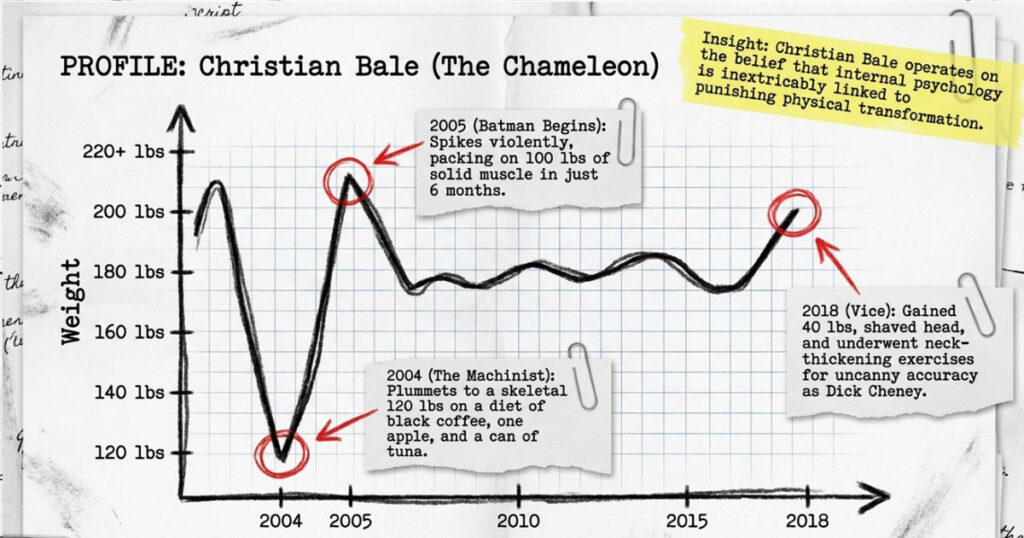
Christian Bale is renowned globally for his astonishing, sometimes terrifying physical transformations, a key tenet of his specific Method approach. Bale operates on the belief that a character’s internal psychology is inextricably linked to their physical form. He doesn’t just act the part; he punishes and alters his body to fit the mold.
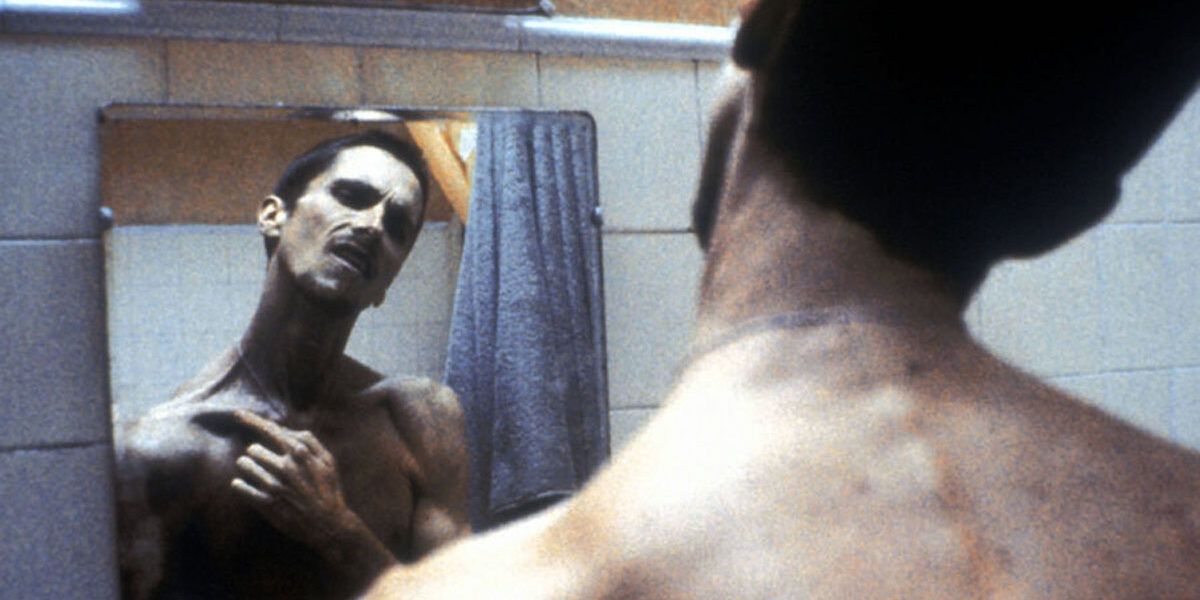
- The Machinist (2004): In perhaps his most alarming transformation, Bale lost a staggering 62 pounds (dropping to a skeletal 120 pounds) to play Trevor Reznik, a factory worker suffering from severe insomnia. He achieved this by subsisting on a daily diet of black coffee, one apple, and a single can of tuna.
- Batman Begins (2005): Immediately following the wrap of The Machinist, Bale had only six months to physically transform into Bruce Wayne. He packed on 100 pounds of solid muscle through a grueling regimen, bulking up so much that director Christopher Nolan actually asked him to lose 20 pounds before filming began.
- The Fighter (2010): Bale lost significant weight again and studied the specific mannerisms of crack addiction to play Dicky Eklund, winning an Oscar for his jittery, hyper-kinetic performance.
- Vice (2018): Going in the opposite direction, Bale gained 40 pounds, shaved his head, bleached his eyebrows, and underwent extensive neck-thickening exercises to portray former Vice President Dick Cheney, resulting in a performance that was eerily, uncannily accurate.
Female Method Actors: Immersion and Transformation
While the media often focuses on the extreme physical transformations of male actors, the history of Method Acting is deeply enriched by brilliant women who have utilized the technique to deliver staggering performances.
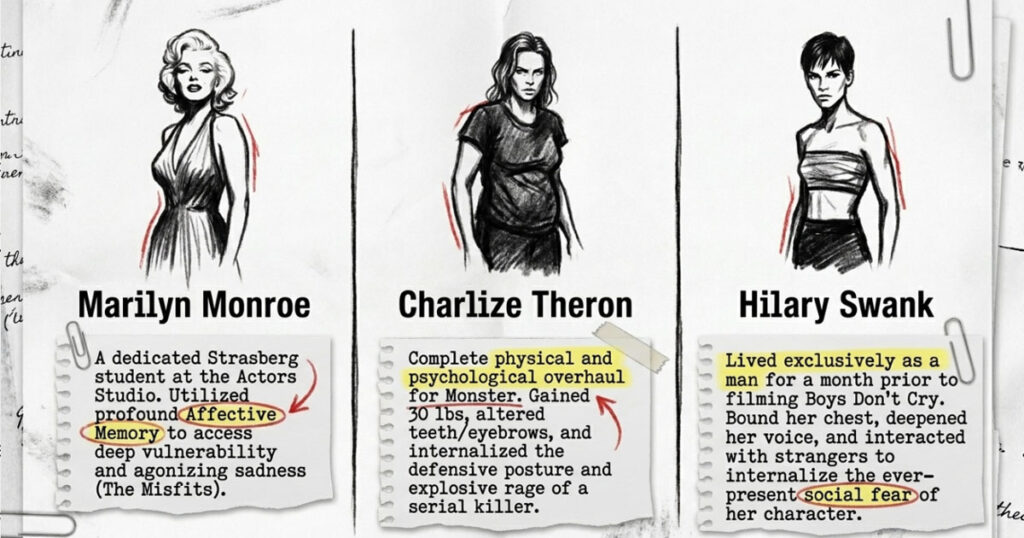
- Marilyn Monroe: Often remembered merely as a glamorous icon, Monroe was a dedicated student of Lee Strasberg and a proud member of the Actors Studio. She relied heavily on Affective Memory to access the deep vulnerability and profound sadness evident in her finest dramatic performances, such as in The Misfits (1961). Strasberg considered her one of his most talented, albeit fragile, students.
- Charlize Theron: For her Oscar-winning role as serial killer Aileen Wuornos in Monster (2003), Theron underwent a complete physical and psychological overhaul. She gained 30 pounds, shaved her eyebrows, wore prosthetic teeth, and most importantly, internalized Wuornos’s defensive posture, trauma, and explosive rage. Theron lived in the mindset of the character, delivering a performance of terrifying empathy.
- Hilary Swank: To prepare for her breakout role as Brandon Teena, a trans man in Boys Don’t Cry (1999), Swank lived as a man for a month before filming began. She cut her hair, bound her chest, deepened her voice, and interacted with strangers exclusively as a man to understand the social dynamics and the ever-present fear her character experienced. The total immersion earned her an Academy Award.
Jared Leto: The Provocateur and The Backlash
In recent years, Jared Leto’s approach to Method Acting has brought the technique under intense scrutiny. His methods often bleed into his interactions with cast and crew, crossing the line from artistic immersion into what many consider highly controversial and disruptive behavior.
For his role as the Joker in Suicide Squad (2016), Leto stayed in character constantly off-camera. He famously sent bizarre, unsettling, and highly inappropriate “gifts” to his co-stars, including live rats to Margot Robbie, bullets to Will Smith, and allegedly a dead pig to the rehearsal room. For Morbius (2022), he reportedly used crutches to painstakingly hobble to the bathroom on set to mimic his character’s physical disability. This slowed production down so significantly that the director eventually struck a deal to wheel Leto to the restroom in a wheelchair just to save time.
Leto’s highly publicized antics have sparked a massive debate about the line between artistic commitment and simply acting unprofessionally under the guise of “The Method.”
The Endless Debate: Is Method Acting True Art or Self-Indulgence?
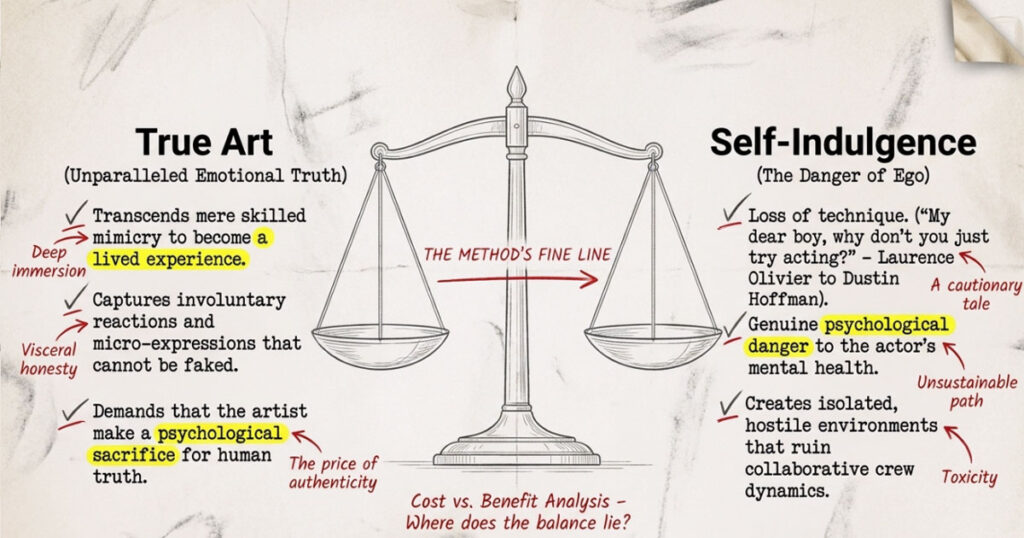
The legacy of Method Acting is profoundly complicated. It is an undeniable fact that it has produced some of the most visceral, raw, and unforgettable performances in cinematic history. Yet, it also invites a fierce philosophical, practical, and ethical debate within the entertainment industry.
The Argument for The Method: Unparalleled Emotional Truth
Advocates argue that Method Acting—when practiced correctly and safely—is the only reliable path to true psychological realism on screen. By deliberately blurring the psychological boundary between the actor and the character, the performance transcends mere imitation or skilled mimicry. It becomes a genuine, lived experience captured by the camera lens.
When an actor like Daniel Day-Lewis or Al Pacino is fully immersed, the audience feels the heavy, undeniable weight of that reality. There is no visible “acting” taking place; there is only being. Proponents argue that the subtle micro-expressions, the involuntary, instinctual reactions, the ragged breathing, and the profound depth of genuine sorrow or rage are simply inaccessible through purely technical, external classical acting methods. The Method forces a terrifying honesty that resonates deeply with the core of the human experience. It demands that the artist bleed for their art.
The Argument Against The Method: The Craft of Illusion and the Danger of Ego
Critics of the Method, particularly its extreme modern iterations, argue that it is fundamentally flawed, deeply self-indulgent, and misses the entire point of what acting is supposed to be. The core counter-argument rests on the philosophical idea that acting is, at its heart, a craft, an illusion, and a professional job—not a psychiatric exercise.
- The Loss of Technique and The Supremacy of Imagination: Classical actors argue that true skill lies in the ability to portray an emotion convincingly without having to actually experience the psychological trauma associated with it. Why traumatize yourself when you have an imagination? This argument is famously encapsulated by an anecdote (which may be slightly apocryphal but remains legendary) involving Sir Laurence Olivier and Dustin Hoffman on the set of Marathon Man (1976). Hoffman had stayed awake for three days straight to look genuinely exhausted for a torture scene. Olivier, a classically trained British titan, looked at the disheveled Hoffman and asked, “My dear boy, why don’t you just try acting? It’s so much easier.”
- The Psychological Danger: Delving repeatedly into one’s own darkest traumas, or deliberately adopting the chaotic, violent psychology of a character like the Joker or a serial killer, can be genuinely damaging to an actor’s mental health. The human brain is not always capable of neatly separating simulated trauma from real trauma. Critics ask: Is capturing a great performance on film truly worth a fractured psyche, a ruined marriage, or severe depression?
- Disruption on Set and Hostile Work Environments: Film sets are massive, highly coordinated collaborative environments involving hundreds of crew members. This delicate ecosystem can be severely hindered by a Method actor who refuses to break character between setups, demands special treatment, holds up production for physical eccentricities, or creates a hostile, unpredictable environment for their co-stars (as seen in the Leto examples). Acting is fundamentally about playing with partners; isolationist, self-centered Method acting can ruin that vital dynamic. Actors like Mads Mikkelsen and Sebastian Stan have recently spoken out against this, calling out extreme Method behavior as “bullshit” and emphasizing the importance of professionalism, empathy for the crew, and the ability to turn the character off when the director yells “Cut.”
The Unresolved Verdict: A Schism in Art
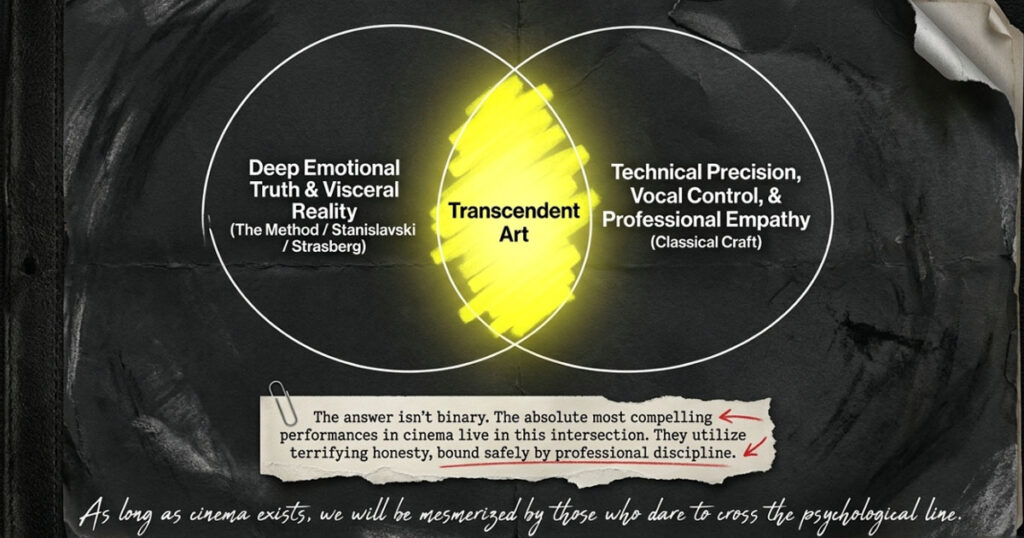
So, after a century of evolution, trauma, and triumph, where does that leave us? The debate between the deep immersion of Method Acting and the technical precision of classical acting remains entirely unresolved. It is a fascinating, unbridgeable schism at the very heart of performance art.
Is true, transcendent acting the ability to completely surrender one’s own identity, to become the empty vessel for another soul, genuinely feeling their agonizing pain and ecstatic joy as your own? If so, the Method is the highest, most noble form of the art, representing a profound psychological sacrifice made by the actor for the sake of uncovering ultimate human truth.
Or is acting a masterclass in empathy, observation, and technical precision—the incredible ability to put on a mask flawlessly, to convince the world you are someone else while remaining firmly, safely grounded in your own reality? If that is the case, perhaps the extreme iterations of the Method are an unnecessary burden, a dangerous indulgence, and a confusing of the artist with the art itself.
Perhaps the answer, like human nature itself, isn’t binary. The absolute most compelling performances in cinema often utilize elements of both schools: the deep, undeniable emotional truth sought by Stanislavski and Strasberg, seamlessly combined with the vocal control, physical discipline, and professional boundaries championed by their loudest critics.
As long as cinema exists, we will continue to be mesmerized by those daring artists who cross the psychological line into the perilous territory of the Method. We will applaud their genius even as we fiercely debate the necessity and the safety of their journey. The magic of a truly great performance remains undeniable, whether it is conjured from the deepest, darkest corners of the actor’s own soul, or crafted through sheer, brilliant, magnificent technique.