The Academy Awards, colloquially known around the globe as the Oscars, represent the zenith of cinematic achievement. To the casual viewer tuning in to the annual broadcast, the ceremony is a glittering celebration of art, celebrity, and storytelling. However, beneath the glamorous veneer of red carpets and tearful acceptance speeches lies a complex, century-long history of corporate strategy, technological upheaval, and intense cultural negotiation.
As we look back on the history of the Academy of Motion Picture Arts and Sciences (AMPAS), it becomes overwhelmingly clear that the institution has never been a static monument to film. Instead, it is a living, breathing entity that has been forced to constantly adapt to survive. From its ruthless, calculated inception in the late 1920s to its modern reckoning with diversity and its upcoming transition to digital-native broadcasting, the evolution of the Academy Awards is, in many ways, the definitive story of the 20th and 21st centuries.
The Genesis of an Institution: 1927–1929
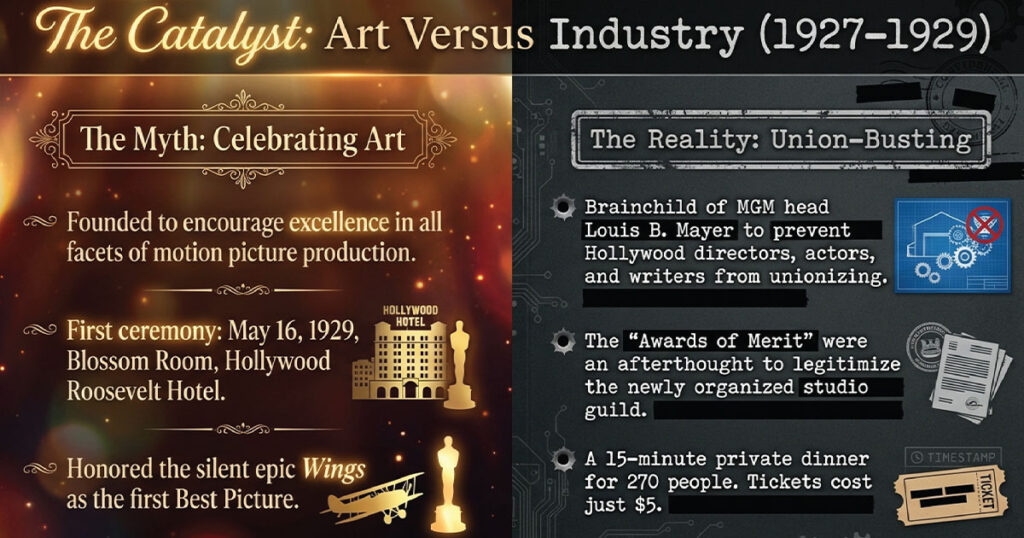
To understand the Oscars, one must first dismantle the myth that the Academy was conceived as an altruistic endeavor to celebrate pure art. In reality, the institution was born as a calculated instrument of institutional hegemony and corporate control.
Established in 1927 by Louis B. Mayer, the formidable head of Metro-Goldwyn-Mayer (MGM) and one of the most powerful men in Hollywood, the Academy served primarily as a strategic labor-management tool. During the late 1920s, the threat of labor unions was beginning to cast a long shadow over the lucrative studio system. Mayer envisioned an elite, invite-only organization that would unite the five disparate branches of the industry—actors, directors, producers, technicians, and writers—under a single, studio-controlled banner. By doing so, he hoped to preempt the formation of independent guilds and maintain absolute executive power.
Mayer understood the psychological power of prestige. By incentivizing production quality through what he dismissively termed “medals,” the Academy sought to stabilize the burgeoning studio system. Mayer famously, and rather cynically, remarked to a colleague that “hanging medals” on filmmakers and actors would lead them to “kill themselves to produce” the prestige content he desired for his theaters.
The 1st Academy Awards: A Snapshot of a Bygone Era
- Date: May 16, 1929
- Venue: Hollywood Roosevelt Hotel (The Blossom Room)
- Ticket Price: $5 (Approximately $92 when adjusted for inflation)
- Attendance: 270 exclusive guests
- Ceremony Duration: A brisk 15 minutes
Unlike the hours-long spectacles of today, the inaugural gathering was a relatively brief and muted affair. There was no suspense; the winners had been announced to the press three months in advance. Yet, this historic night occurred during the industry’s most volatile technological shift: the transition from silent film to “talkies.”
This seismic conflict was epitomized by the Academy’s handling of The Jazz Singer (1927). To maintain the strict category logic of the era, the film was barred from competing for Best Picture (then known as “Outstanding Picture”). The Board of Governors deemed it fundamentally unfair for a sound-synchronized film to compete against traditional silent works. Instead, the Academy executed a strategic political maneuver, honoring Warner Brothers with a Special Award for pioneering the technology without disrupting the competitive field. Consequently, the World War I aviation epic Wings remains the only fully silent film to win the top honor in the institution’s history, marking a fleeting moment of equilibrium before the talkie revolution achieved total dominance over the medium.
The Anatomy of an Icon: Design, Symbolism, and Ownership
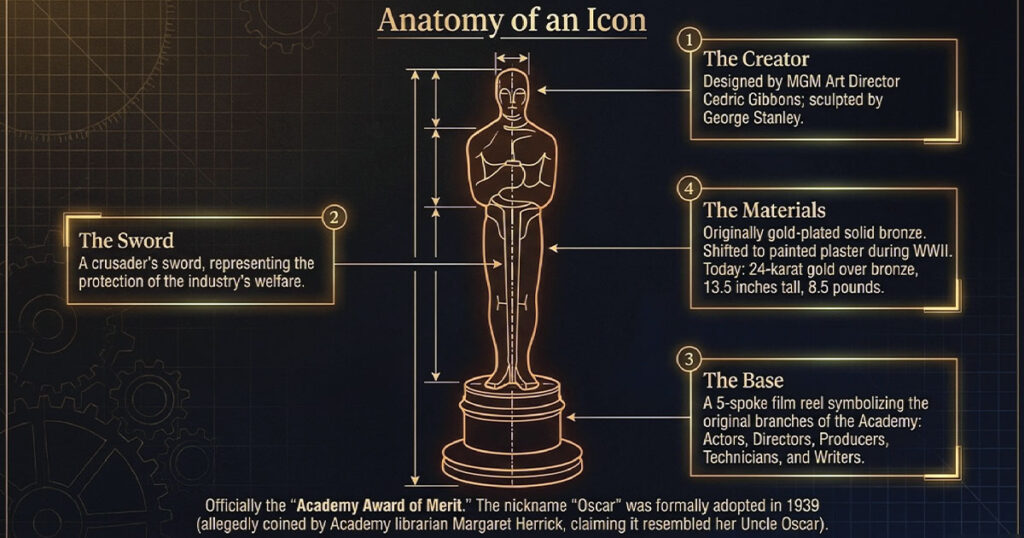
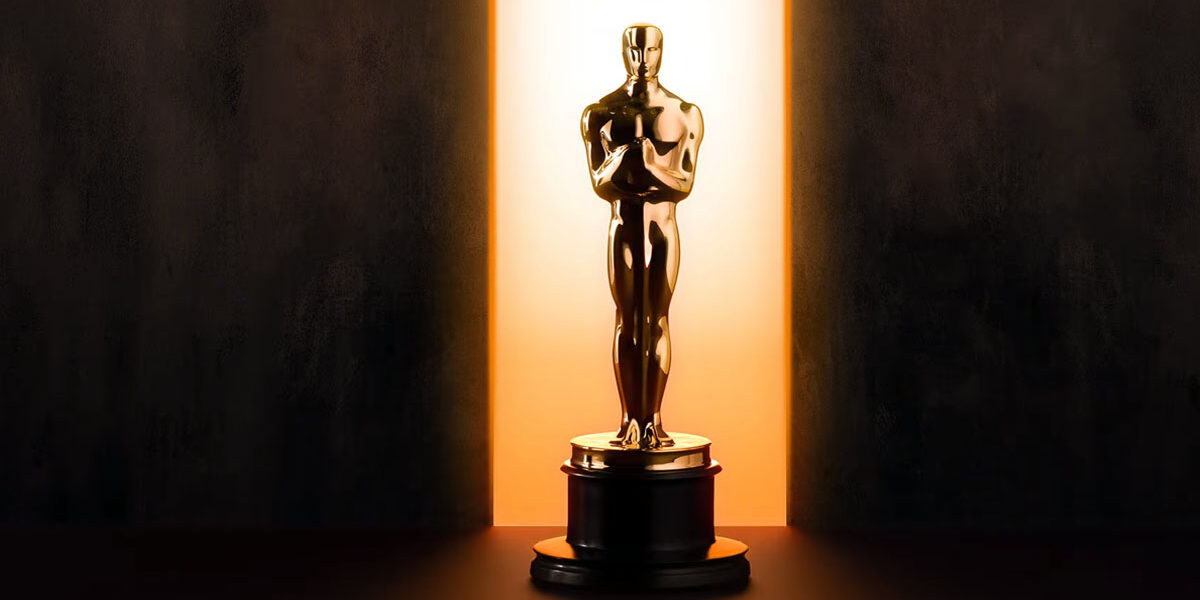
The Oscar statuette, officially titled the “Academy Award of Merit,” serves as the physical manifestation of industry prestige. It remains arguably the most recognized trophy in the world, rivaled only perhaps by the Olympic Gold Medal or the FIFA World Cup. Beyond its aesthetic value, the statuette functions as a vital component of Hollywood’s global branding. Winning an Oscar establishes a tangible standard of excellence that confers significant pay bumps, international prominence, and career-defining legitimacy upon its recipients.
Physical Design and Deep Symbolism
The iconic figure was sculpted by Los Angeles artist George Stanley from a conceptual sketch by MGM’s legendary art director, Cedric Gibbons. The statue is steeped in the geometric elegance of the Art Deco movement of the 1920s.
- The Knight’s Pose: The figure is a stoic, idealized knight clutching a crusader’s sword, standing confidently atop a reel of film. It represents the noble crusade for artistic perfection.
- The Five Spokes: If you look closely at the film reel beneath the knight’s feet, it features exactly five spokes. These explicitly represent the Academy’s original five founding branches: Actors, Directors, Producers, Technicians, and Writers.
- Material Evolution: The physical composition of the award has changed with the times. Originally crafted from gold-plated solid bronze, the Academy later shifted to Britannia metal (a smooth, pewter-like alloy) before applying the 24-karat gold plating. During the “war-time” metal shortages of the 1940s, when resources were diverted to the World War II effort, the Academy issued painted plaster Oscars. Once the conflict ended, recipients were invited to exchange their plaster stand-ins for the traditional metal versions. Today, the statuettes are manufactured by Polich Tallix (now UAP) in New York, standing 13.5 inches tall and weighing a substantial 8.5 pounds.
The Mystery of the Name “Oscar”
The moniker “Oscar” is shrouded in competing claims of historical origin. While the name was officially adopted by the Academy in 1939, its true genesis is fiercely debated:
- Margaret Herrick: The Academy’s first librarian (and eventual executive director) claimed she named it in 1931 because the statue bore a striking resemblance to her “Uncle Oscar” (a nickname for her cousin, Oscar Pierce).
- Bette Davis: The legendary actress frequently claimed she named the trophy after her first husband, bandleader Harmon Oscar Nelson, stating the statue’s posterior matched his.
- Sidney Skolsky: The Hollywood columnist is credited with the first documented newspaper reference to the name in a 1934 article, claiming he used it to mock the Academy’s pretentiousness.
- Eleanore Lilleberg: Recent cinematic scholarship suggests the most likely credit belongs to Lilleberg, an early Academy secretary. Her brother recalled her naming the figure after a Norwegian army veteran she knew who “stood straight and tall.”
The Black Market and the $1 Rule
The Academy maintains rigid, almost draconian control over these symbols of merit through legal encumbrances. Since 1950, all winners have been legally bound by a strict “buy-back” rule: if a recipient or their heirs ever wish to sell a statuette, they must first offer it back to the Academy for the sum of $1.
This policy ensures the Academy retains total ownership of its narrative and prevents the cheap commodification of its highest honor. However, Oscars awarded before 1950 are not bound by this agreement, creating a highly lucrative black market. For instance, World War II veteran Harold Russell sold his 1946 Oscar for $60,500 in 1992 to fund his wife’s medical expenses. More remarkably, Orson Welles’s 1941 Oscar for Citizen Kane—unencumbered by the return agreement—was sold at auction for a staggering $861,542 in 2011. To protect the award’s sanctity, prominent figures like Steven Spielberg have actually purchased orphaned pre-1950 Oscars at auction solely to donate them back to the Academy’s vault.
Structural Evolution: Voting, Categories, and the Secrecy Mandate
The strategic necessity of maintaining institutional legitimacy has historically required the Academy to implement rigorous voting and secrecy protocols. The envelope-opening suspense that defines the modern broadcast was not originally part of the plan.
For the first decade, the Academy gave the names of the winners to newspapers in advance for publication at 11:00 PM on the night of the ceremony. However, in 1940, the Los Angeles Times broke this industry embargo, publishing the winners in its evening edition long before guests even arrived at the banquet. Nominees walked into the venue already knowing they had lost. To restore the narrative control and suspense essential to its prestige, the Academy adopted the famous sealed-envelope secret-ballot protocol in 1941, enlisting the auditing firm Price Waterhouse (now PricewaterhouseCoopers, or PwC) to count the votes—a partnership that endures to this day.
The Modern Voting Process
Today, the Academy—which has grown from five branches to nineteen distinct craft branches—utilizes two primary methodologies to ensure representativeness:
- Plurality Voting: Applied to the vast majority of categories (like Best Director, Best Actor, Best Cinematography). The nominee who secures the highest total vote count wins the category.
- Ranked-Choice (Preferential) Voting: Implemented exclusively for the Best Picture category since 2009 (when the nominee field expanded from five to up to ten films). Under this system, voters rank the nominees from first to last. If no film achieves a 50% plus one majority in the first round of counting, the lowest-performing films are eliminated. Those votes are then redistributed to the voters’ second choices, a process that continues until a majority winner emerges.
The Strategic “So What?”: The preferential system is highly calculated. It is designed to produce a true “consensus winner.” It naturally favors a film that is broadly liked and respected across the Academy’s highly diverse branches, effectively preventing a deeply polarizing film—one loved fiercely by a few but disliked by many—from winning Best Picture with a small plurality in a crowded field.
Furthermore, the Academy’s category management acts as a historical mirror reflecting the ongoing evolution of cinematic craft. Discontinued honors like “Best Engineering Effects,” “Best Title Writing,” and “Best Dance Direction” highlight an early era where the institution was still defining the boundaries of the medium. Conversely, the introduction of “Best Animated Feature” in 2001, and upcoming progressive categories like “Best Casting” (debuting in 2026) and “Best Stunt Design” (slated for 2028), signal an institutional shift toward recognizing previously marginalized, yet absolutely vital, technical contributions.
From Radio to Global Spectacle: The Media Transformation
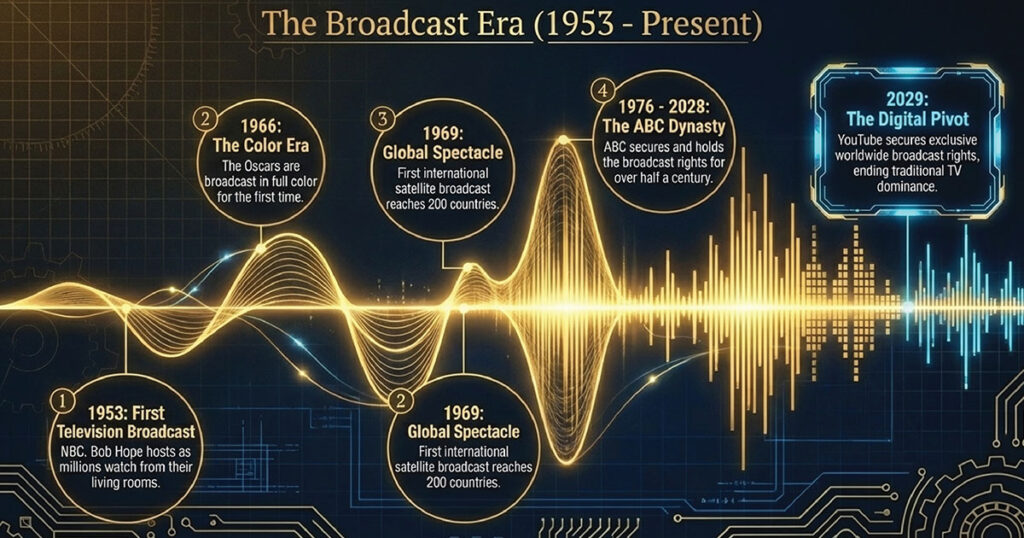
The transition from private, exclusionary industry banquets to a massive public media event transformed the Academy Awards into the primary promotional engine for global Hollywood. This media transformation occurred through a series of crucial technological milestones that brought the magic of cinema directly into the public’s living rooms:
- 1930: The first live radio broadcast of the ceremony (a local Los Angeles one-hour program).
- 1944: The first network radio coverage, accompanied by an overseas broadcast directed specifically to American GIs fighting in WWII, positioning Hollywood as a pillar of American morale.
- 1953: The first televised ceremony, broadcast in black-and-white on NBC and hosted by the legendary Bob Hope, bridging the gap between coastal elites and Middle America.
- 1966: The first broadcast in full color, allowing audiences to finally experience the dazzling fashion of the red carpet.
- 1970: The first international satellite broadcast, reaching fifty countries simultaneously and solidifying Hollywood’s global cultural dominance.
- 2029: In a landmark shift reflecting the death of traditional cable television, the ceremony will move exclusively to digital-native distribution via YouTube, following the conclusion of its decades-long contract with ABC in 2028.
Throughout the television era, a stark, undeniable correlation has existed between mainstream box-office success and television ratings, underscoring the Academy’s reliance on popular culture for its cultural legitimacy. The 70th Academy Awards in 1998 reached an all-time record of 57.24 million viewers, driven entirely by the massive cultural footprint of James Cameron’s Titanic. Similarly, the 76th ceremony in 2004 drew a massive 43.56 million viewers to watch The Lord of the Rings: The Return of the King sweep its categories.
In contrast, years that favor smaller, independent cinema often result in severe audience contraction. The 2008 broadcast fell to a then-record low of 32 million viewers, and the 2021 pandemic-era ceremony reached a historic, terrifying nadir for the Academy of just 10.4 million viewers. This desperate need for global saturation and high viewership has increasingly exposed the institution to intense social pressures and the demands of an evolving, socially conscious audience.
#OscarsSoWhite and the Modern Inclusivity Mandate
For decades, the Academy operated as an exclusive, mostly white, mostly male club. This demographic reality came to a crashing halt with the #OscarsSoWhite movement. Launched by media activist April Reign in 2015 via a simple hashtag on Twitter, it served as the catalyst for the most significant organizational, structural, and cultural reforms in the Academy’s century-long history.
Triggered initially by a shocking lack of diversity in the acting nominations—resulting in an all-white slate of 20 acting nominees for two consecutive years—and the perceived “snubs” of critically acclaimed Black-led films like Selma, the movement violently challenged the institution’s demographic homogeneity. The statistics of the time were damning: in 2013, a rigorous demographic study revealed the voting membership of the Academy was 93% white, 76% male, and had a median age of 62.
Facing an existential crisis of relevance, the Academy initiated “historic” and rapid changes by 2016 to ensure its long-term viability and moral standing.
Institutional Response and Demographic Overhaul
The Academy implemented a comprehensive, aggressive membership expansion plan known as “A2020,” pledging to double the number of women and diverse voters within four years:
- Explosive Membership Growth: The Academy began extending invitations at an unprecedented rate. In 2018 alone, a record 928 new members from 59 countries were invited.
- The 2020 Milestone: By the end of 2020, the Academy successfully met its goal. The new membership composition shifted dramatically, with people of color comprising 38% of the incoming class, while the total active membership reached a composition of 45% women and 36% underrepresented ethnic/racial communities.
- The 2024 Standards: The true culmination of the #OscarsSoWhite movement arrived with the 2024 ceremony. The Academy transitioned from merely “encouraging diversity” to implementing “mandated eligibility.” To even qualify for a Best Picture nomination, films must now submit a confidential Academy Inclusion Standards form and meet strict thresholds regarding the representation of women, LGBTQ+ individuals, cognitive/physical disabilities, and underrepresented racial groups among the cast, crew, and marketing teams.
These systemic changes have already yielded tangible historical milestones on the stage. The nomination of Black Panther (the first superhero film nominated for Best Picture), the unprecedented triumph of Parasite (the first non-English language film to win Best Picture in 2020), and the sweeping victory of Everything Everywhere All at Once (celebrating an entirely Asian-led ensemble) signify the Academy’s earnest, if belated, attempts to bridge the vast gap between its history of exclusion and current global cultural realities.
Conclusion: The Academy Awards “Then and Now”
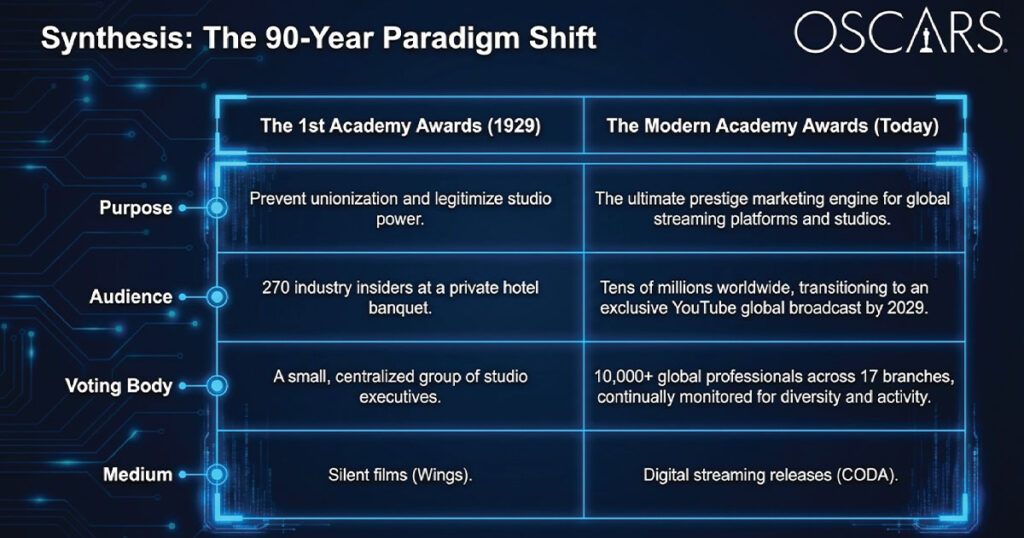
The grand trajectory of the Academy Awards—from a smoke-filled, 15-minute private dinner in 1929 to a multi-hour, highly scrutinized global digital event broadcast in over 200 territories—deeply reflects the broader socio-economic evolution of the 20th and 21st centuries.
Looking at this 100-year timeline, the institution’s survival can be attributed to its “Three Pillars of Transformation”:
- Technological: The seismic shift from the advent of the silent era, through the birth of sound and color broadcasting, all the way to a future defined by digital-native streaming and algorithmic distribution.
- Structural: The transition from intimate, heavily controlled studio banquets to high-stakes, independently audited digital spectacles managed by global accounting firms to ensure unimpeachable integrity.
- Cultural: The painful but necessary movement from a homogenous, insular body focused solely on studio control to a sprawling, international institution that mandates strict standards for global, intersectional representation.
Despite persistent modern criticisms regarding “category fraud” (the strategic manipulation of lead versus supporting actor campaigns by studios to increase winning odds) and the perennial audience exhaustion with predictable “Oscar bait” biopics, the Academy Award remains the film industry’s absolute zenith of achievement.
Its enduring power and status are intimately tied to its capacity for adaptation. The Academy has proven that it is willing to break its own rules, change its voting systems, and overhaul its entire membership to stay relevant. Because of this adaptability, even as the very definition of a “movie” moves away from physical celluloid projected in theaters toward digital streams consumed on smart devices, the gleaming golden knight remains the ultimate arbiter of cinematic immortality.