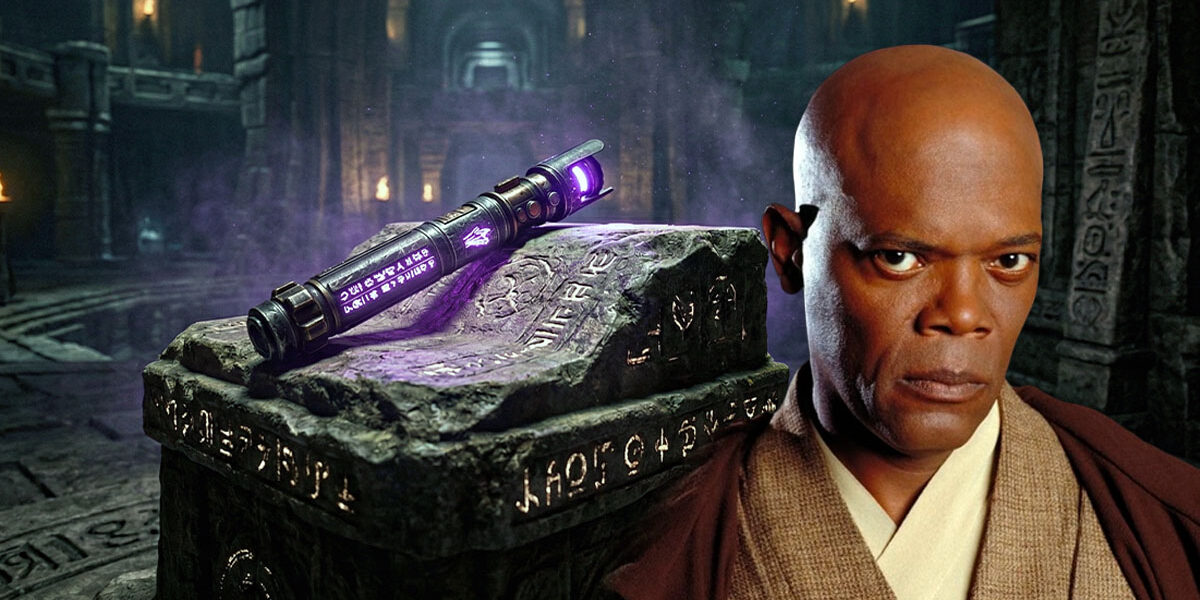
In the vast and ever-expanding universe of Star Wars, the hum of an igniting lightsaber is an unmistakable sound. While fans are deeply familiar with the heroic blues and greens of the Jedi, or the sinister reds of the Sith, there is one color that instantly commands attention and respect: Purple.
Most famously wielded by Jedi Master Mace Windu, the purple lightsaber is incredibly rare. But what does it actually mean? Is it just a cool aesthetic, or is there a deeper mythology attached to it?
Let’s ignite the kyber crystal and dive deep into both the fascinating in-universe lore and the hilarious real-world origin behind the purple lightsaber.
The In-Universe Lore: Walking the Line Between Light and Dark
In Star Wars lore, a lightsaber gets its color from a Kyber crystal. In their natural state, these crystals are colorless. They only gain their hue when a Force-sensitive individual forms a deep, spiritual bond with them during a rite of passage known as “The Gathering.” The crystal essentially reflects the user’s personality, connection to the Force, and their destined path.
From a purely symbolic standpoint, purple is a mix of blue and red. In the context of the Force, this represents a perfect, yet highly dangerous, balance.
A purple lightsaber signifies a Jedi who utilizes both the Light and Dark sides of the Force. These warriors possess an inherent darkness, aggression, and passion—traits typically associated with the Sith (represented by red). However, unlike the Sith, a purple lightsaber wielder has the ultimate discipline and willpower to control these dark tendencies, using them to serve the Light (represented by blue).
Form VII: The Mastery of Vaapad
To truly understand the purple lightsaber, we must look at its most famous owner: Mace Windu. Windu was not just a powerful Jedi Master; he was the creator of a unique and highly controversial lightsaber combat style known as Vaapad (Form VII).
Before Vaapad, Form VII was known as Juyo, a vicious and aggressive fighting style that was essentially banned by the Jedi Order because it required the user to draw upon their anger and bloodlust, often leading them straight to the Dark Side.
Mace Windu recognized his own inner darkness. Instead of repressing it, he created Vaapad—a state of mind as much as a fighting style. When using Vaapad, Windu channeled his own inner darkness, as well as the darkness of his opponent, transforming himself into a superconducting loop of Force energy. He enjoyed the thrill of the fight and used his aggressive instincts to fuel his strikes, yet he maintained an iron-clad grip on his morality.
The purple lightsaber is the physical manifestation of this philosophy. It shows that Windu is dipping his toes into the Dark Side’s power without ever allowing it to corrupt his soul.
The Real-World Origin: A Hollywood Legend
While the in-universe explanation of moral ambiguity and Form VII is incredibly deep and satisfying, the real reason the purple lightsaber exists in Star Wars is purely Hollywood magic.
During the production of Star Wars: Episode II – Attack of the Clones, the climactic Battle of Geonosis featured dozens of Jedi fighting simultaneously in a massive arena. Samuel L. Jackson, the legendary actor portraying Mace Windu, looked at the chaotic scene and realized he wouldn’t be able to spot himself on screen amidst a sea of blue and green blades.
Jackson took matters into his own hands and approached George Lucas with a simple, yet bold request.
In a now-famous behind-the-scenes interview, Jackson revealed his conversation with the Star Wars creator: “We had this massive arena scene, and I asked George, ‘Can I get a purple lightsaber?'”
Initially, Lucas shot the idea down. He explained the strict, established rules of his universe: “Good guys get green and blue, bad guys get red. That’s just the way it works.”
But Jackson, being the charismatic force that he is, simply replied, “Yeah, but I want a purple one. I’m like the second baddest Jedi in the universe next to Yoda!”
Lucas eventually relented, telling Jackson he would think about it. A few days later, Lucas showed Jackson a rough, unfinished effect shot of Mace Windu wielding a brilliant amethyst blade. Jackson’s reaction was exactly what you would expect: pure joy.
Because of one actor’s desire to stand out on the big screen, the lore of Star Wars was forever changed, forcing writers to create the brilliant backstory of Vaapad to justify the new color.
Other Notable Purple Wielders (Legends)
While Mace Windu is the undisputed poster child for the purple blade in the official canon, the Expanded Universe (now known as Star Wars Legends) featured a few other notable characters who wielded the amethyst blade, further solidifying its meaning:
- Revan: The legendary figure from the Knights of the Old Republic era famously wielded a purple lightsaber (alongside a red one). Revan’s entire character arc is defined by walking the path of both a Jedi Knight and a Sith Lord, making purple the perfect color for his complex soul.
- Mara Jade Skywalker: Originally the “Emperor’s Hand” (a dark side assassin for Palpatine), Mara Jade eventually broke free from her dark past, became a Jedi Master, and married Luke Skywalker. Her transition from dark to light was symbolized by her use of a purple lightsaber, acknowledging her history while embracing her new path.
Conclusion
The purple lightsaber is a masterpiece of accidental storytelling. What started as a simple request from Samuel L. Jackson to find himself on a crowded movie screen evolved into one of the most compelling pieces of lore in the Star Wars mythos.
It stands as a testament to the fact that the Force is not always black and white (or blue and red). Sometimes, true mastery requires acknowledging the darkness within and having the absolute willpower to control it.